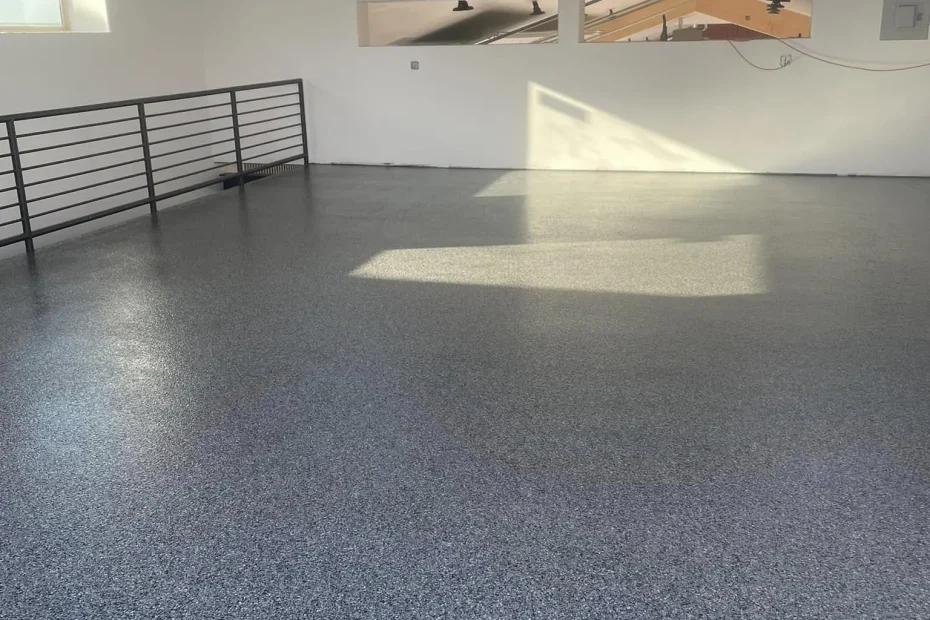
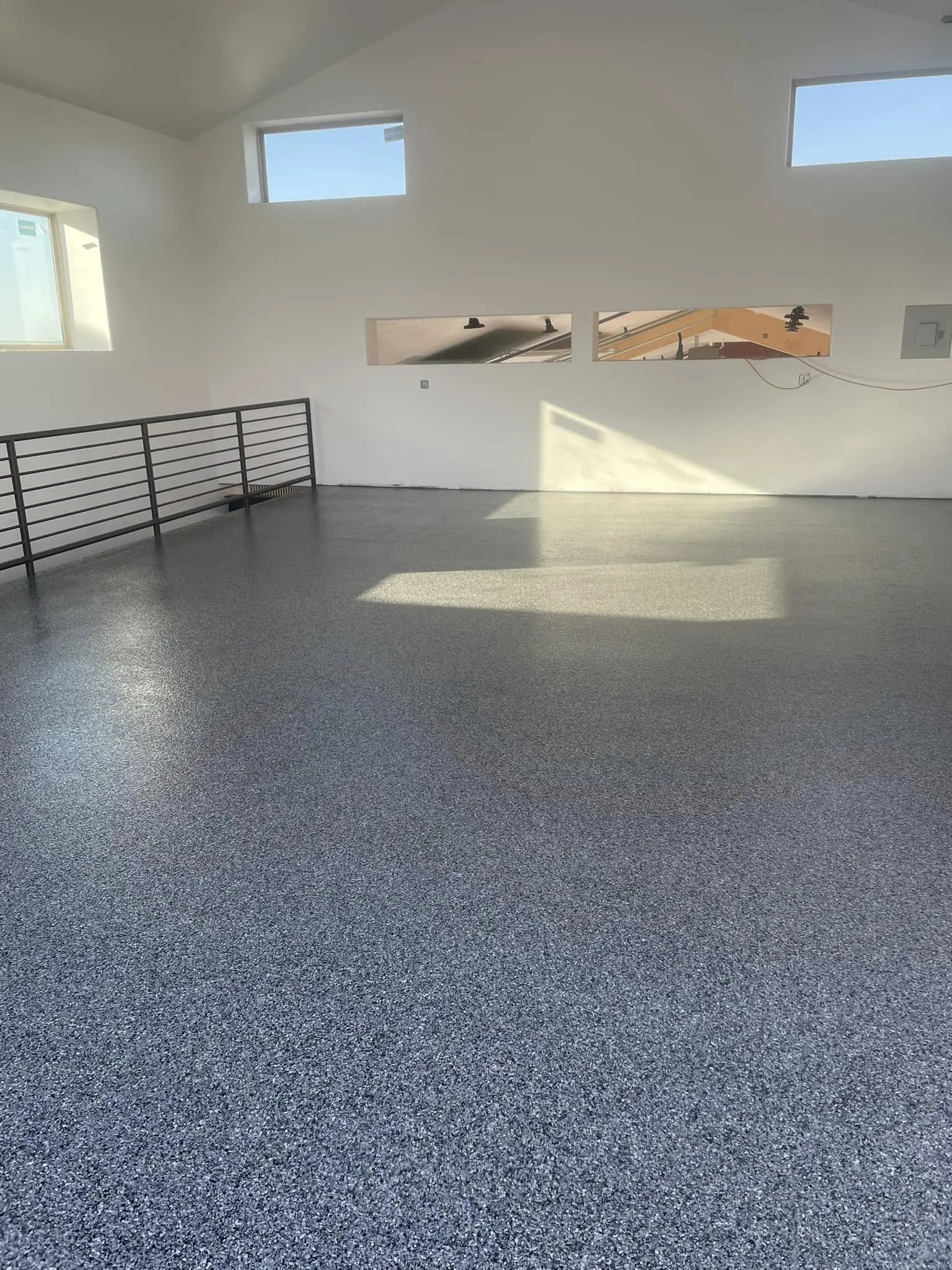
Polyaspartic wins for Lakewood garages. It’s UV-stable (won’t amber under Colorado sun), hot-tire rated, cures in 6 to 8 hours vs. 24 to 72 for standard epoxy topcoat, and performs better through Jefferson County freeze-thaw cycles. Standard epoxy topcoat is cheaper upfront but yellows within 3 to 5 years at elevation.
What the Topcoat Actually Does
The topcoat is the final layer of a floor coating system. It’s what your tires sit on, what your feet touch, and what takes chemical spills. It determines gloss level, UV stability, and scratch resistance. The base coat (usually 100 percent solids epoxy) is about adhesion and film build. The topcoat is about long-term performance.
Most floor coating marketing focuses on the base coat: “100 percent solids epoxy” sounds impressive. What often goes unmentioned is what’s on top. A premium epoxy base with a bargain urethane topcoat will fail faster than the base coat marketing suggests.
Why Epoxy Topcoats Struggle in Lakewood
Standard epoxy topcoats are aromatic, meaning the chemical backbone includes benzene rings that UV light degrades. Lakewood sits at 5,430 feet with roughly 300 sun days per year. At elevation, UV intensity is about 25 percent higher than sea level. An aromatic epoxy topcoat in Lakewood yellows and chalks in 3 to 5 years, sometimes faster in south or west-facing garages that get afternoon sun.
The yellowing isn’t just cosmetic. As the topcoat degrades, it becomes more brittle and loses chemical resistance. Hot tires parked on a degraded epoxy topcoat can leave marks or cause surface delamination. The floor that looked great at year one looks tired at year four.
Why Polyaspartic Holds Up Better
Polyaspartic is an aliphatic polyurea. The aliphatic designation means the backbone is UV-stable: the chemical structure doesn’t break down under UV exposure. After 10 years under Lakewood sun, a polyaspartic topcoat still looks like it did at year two. No yellowing, no chalking, same chemical resistance.
Cure speed is the other advantage. Polyaspartic topcoats cure in 6 to 8 hours at normal Colorado temperatures. Standard epoxy topcoats need 24 to 72 hours. For Lakewood homeowners who cleared the garage and want their cars back in it, polyaspartic means same-day return. A job started at 7am can accept light foot traffic by mid-afternoon and vehicles by evening.
Temperature Performance Through Jefferson County Winters
Epoxy installations have a temperature floor: below about 55°F the chemistry slows dramatically and below 35 to 40°F it stops curing correctly. Lakewood winters drop into single digits. Standard epoxy topcoat work is seasonal, practically speaking.
Polyaspartic has a broader install temperature window: some formulations can go down to 0°F. Not that we’d choose to install at 0°F, but the wider range means earlier spring and later fall scheduling. For Lakewood homeowners who need work done outside peak season, polyaspartic is the more flexible option.
Cost Difference
Polyaspartic topcoat adds 10 to 15 percent to the total system cost versus a standard epoxy topcoat. On a typical Lakewood garage floor job, that is a modest difference. Over 10 years, that delta is far outpaced by the cost and inconvenience of recoating an epoxy-topcoated floor that yellowed. Most Lakewood homeowners see the math quickly once it’s laid out.
We include polyaspartic topcoat in our standard Lakewood system. It’s not an upgrade option.
Topcoat FAQ
Can I get a matte polyaspartic topcoat?
Yes. High-gloss is standard and most popular. Satin and low-gloss options are available. Matte topcoats tend to show footprints more than gloss. Ask at the on-site look about finish options for your specific space.
Does the topcoat matter if the garage doesn’t get direct sun?
Less so, but still matters for hot-tire resistance and chemical resistance. If your Lakewood garage gets indirect light only, standard epoxy topcoat would last longer than in a sun-direct installation. We still recommend polyaspartic for the cure speed advantage alone.
What about urethane topcoats?
Aliphatic urethane topcoats are also UV-stable and a valid alternative to polyaspartic. They tend to have longer open time (easier for contractors to work with) and similar UV performance. Polyaspartic is faster-curing. Both are significantly better than standard epoxy topcoats for Lakewood’s UV exposure.
How do I know which topcoat my current floor has?
If your floor is 3 to 7 years old and shows any yellowing or hazing, it likely has an aromatic epoxy or urethane topcoat. If it still looks clear and doesn’t have hot-tire marks, it was probably finished with a polyaspartic or aliphatic urethane. We can assess at an on-site look.
What’s your warranty on the topcoat?
Lifetime warranty on the full coating system including topcoat. Covers delamination, peeling, and hot-tire failure. Normal wear (surface scuffs) isn’t covered but the topcoat’s hardness handles daily use well.
Ready to See What a Polyaspartic System Looks Like?
Free on-site look covers system options, topcoat choices, and pricing for your Lakewood garage.
Call (720) 635-0282 Schedule a Free Look