Evergreen Garage Coatings
A garage at roughly 7,200 feet earns its keep. Evergreen winters bring heavy snow load and a long freeze season, trucks drag in sand and magnesium chloride, and well water leaves minerals on bare concrete. Plenty of these garages are detached and unheated, swinging hard between sun and shade. Elevated Epoxy Co coats garage floors in Evergreen, Bergen Park, Hiwan and Kittredge, and a typical two-car garage takes a day, sometimes a day and a half.
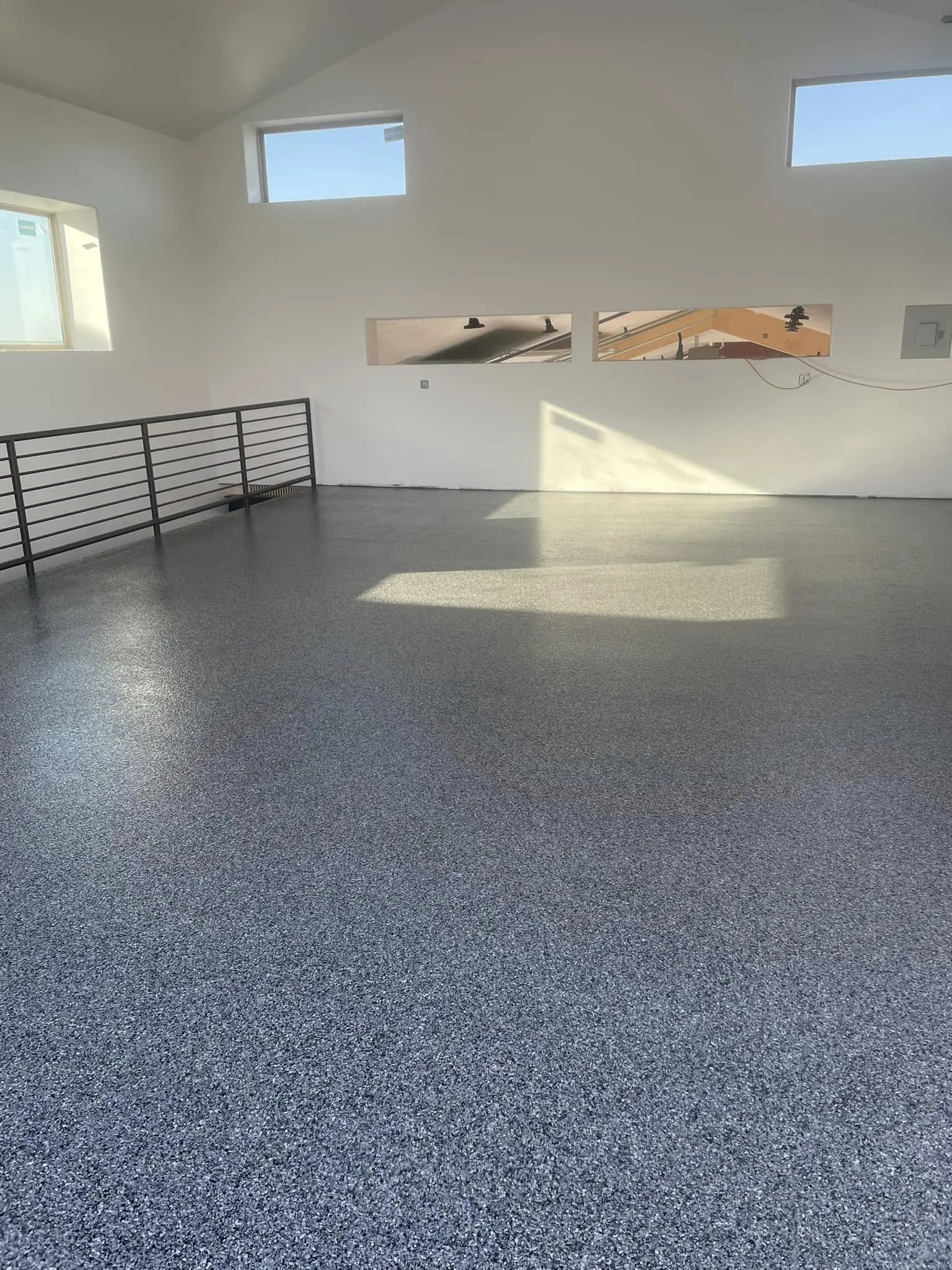
What Goes Down on an Evergreen Garage Slab
Most garage floors we put down in Evergreen are four layers. A 100 percent solids epoxy primer soaks into the freshly ground concrete. Vinyl flake gets thrown into that wet base until it will not hold another chip. Then a polyaspartic topcoat seals the flake, and a slip-resistant pass goes on last. Dry, the whole build comes to about 25 to 30 mils. The flake covers the scars an older slab picks up. The topcoat handles hot tires and road grime, and that last pass gives your boots something to grip when snow melts off the truck.
When a coated floor lets go early, prep is almost always the reason. We grind the slab with 30-grit metal-bond diamonds until clean aggregate shows, then vacuum it down. Control joints and cold-pour cracks get filled with polyurea. Then we test the slab for moisture. Cold mountain concrete pushes vapor up through itself, and a coating laid over that vapor will lift. If well water has left a mineral crust near a sink or a hose bib, grinding takes it off first so the primer bonds to clean concrete.
Snow load is a fact of every Evergreen winter, and so is the meltwater that comes with it. Each trip in off the road brings snow packed in the tire treads and stuck to boots, and it all ends up as a puddle just inside the door. On smooth concrete that puddle is where people go down. The slip-resistant pass puts texture into the topcoat, so the floor stays walkable wet. If you carry firewood through the garage all winter or haul skis and snow gear in and out every weekend, you will feel that grip every week.
A lot of Evergreen garages are detached and unheated, and they swing hard between sun and shade. The strip by the door can warm up by midday while the back corner stays close to freezing. Resin that goes down cold tends to haze over and cure soft. On cold jobs we use cold-rated product and heat the space so the base coat and topcoat set hard and clear. We check the concrete temperature too, because a slab sitting on frozen ground stays colder than the air above it.
Flake Colors for a House You Plan to Keep
People in Evergreen tend to stay in their homes a long time, so they choose a garage floor for the long haul. Durability beats trend in this town. Grays, tans and browns are the usual picks, and they hide a week of road sand between sweeps. Some owners want a custom blend with copper, slate or blue worked in. Solid-color epoxy with no chip gives a plainer look, and metallic epoxy under a clear polyaspartic coat is the showpiece choice, usually for a finished lower level more than a working garage.
We bring chip samples up the hill and lay them right on your slab. A sample under bright store lights looks nothing like it does in a detached garage with one window and a door that sits in shade half the day. Seeing it on your own concrete, in your own light, is the only fair way to choose.
How Long the Garage Is Out of Service
A two-car garage in Evergreen usually takes a day to a day and a half. Three-car and oversized garages run a day and a half to two. You can walk on the floor 24 hours after the last coat and park on it at 72 hours. A storm in the forecast can push an install date, so we watch the weather and talk through clearing out the garage about three days ahead.
Sun is strong at 7,200 feet. In a garage with a south-facing door or window, plain epoxy yellows in the bright strip near the door while the shaded back of the floor keeps its color, and you end up with a two-toned floor. Polyaspartic holds its color under that UV. It is one more reason every garage we coat gets polyaspartic as the top layer instead of straight epoxy.
Magnesium chloride is the other problem. Trucks drag it in with road sand all winter, and on bare or painted concrete it soaks in, then leaves spalling and a chalky white bloom behind. On a ground, primed and sealed floor it has nowhere to go. It stays on the surface until you mop it, and the concrete below stays sound. For a garage that also holds firewood, trail bikes and lake gear, that easy cleanup matters as much as the look.
A Garage Floor That Mops Clean After a Storm
Call (720) 635-0282 or send a message, and we will make the drive up from Parker to measure. The gallery shows garage floors we have already finished.
Evergreen Garage Coatings FAQ
How much does it cost?
Square footage and the number of bays set the starting point. Prep moves it from there, since old paint, soaked-in oil and cracks that need filling all add grinding time. Metallic sits above flake, and a three-car garage runs more than a two-car. We measure on site, so the number you get is for your garage and nobody else’s.
Will it crack in the cold?
The polyaspartic topcoat flexes with Evergreen’s freeze cycles and the swing between sun and shade. If a coated floor cracks, the slab under it moved. Control joints and cold-pour cracks get filled with polyurea before we coat, so they do not show back through.
Does road sand hurt the floor?
Not a sealed one. Cured polyaspartic is non-porous, so the sand your tires carry in sweeps off the surface. On bare concrete that same sand grinds a dull, stained path down the middle of the garage.
How soon can I drive on it?
Walk on it after 24 hours and park on it after 72. Dry mountain air helps the cure along, but give it the full 72 hours before a vehicle rolls in.
How long does the install take?
Most Evergreen garages are a one-day job. We grind in the morning, fill cracks and joints, lay the base coat and throw flake until it will not take more, then scrape and vacuum the loose chip before the topcoat goes on. A floor that needs a lot of patching can run into a second day, and we tell you that when we measure.
Do I need to move everything out?
Yes. Grinding and coating need an empty garage. Most people move the snow gear, firewood and bikes to the driveway, a storage pod or another building on the lot until the floor is ready.
Is the floor safe when snow melts on it?
Yes. The last coat has slip-resistant texture built in, so a puddle of meltwater by the door does not turn the floor slick. The grip holds on a sloped garage floor too, and the finish still looks glossy.
Will magnesium chloride damage the coating?
No. Mag-chloride hurts bare and painted concrete because it soaks in, and that is where spalling and white bloom come from. A sealed floor keeps it on the surface. Mop it off after a storm and the slab stays sound.
Can you install in the cold months?
Yes, with some planning. A detached, unheated garage in Evergreen can sit cold for weeks during the freeze season. We use cold-rated product, bring heat into the space, and read the slab temperature before we mix anything, because concrete stays colder than the air long after the afternoon warms up.
Other Evergreen Epoxy Flooring Services
More Evergreen floor work · Browse the gallery · Have Us Measure the Garage
Service Area: Evergreen, CO
We coat garage floors in Evergreen, Bergen Park, Hiwan and Kittredge, from the homes around Evergreen Lake to the lots up Upper Bear Creek. It is a drive up from our shop in Parker, so we group mountain jobs and plan each day around the weather.
The garages up here are rarely simple parking spots. Most hold snow gear, firewood, trail bikes and lake equipment, and many sit detached from the house with no heat. Owners in Evergreen tend to keep their homes a long time, and they ask us how a floor will hold up long before they ask what colors it comes in. We like that question, because the answer comes down to prep, moisture testing and the right topcoat, and those are the parts of the job we spend the most time on.