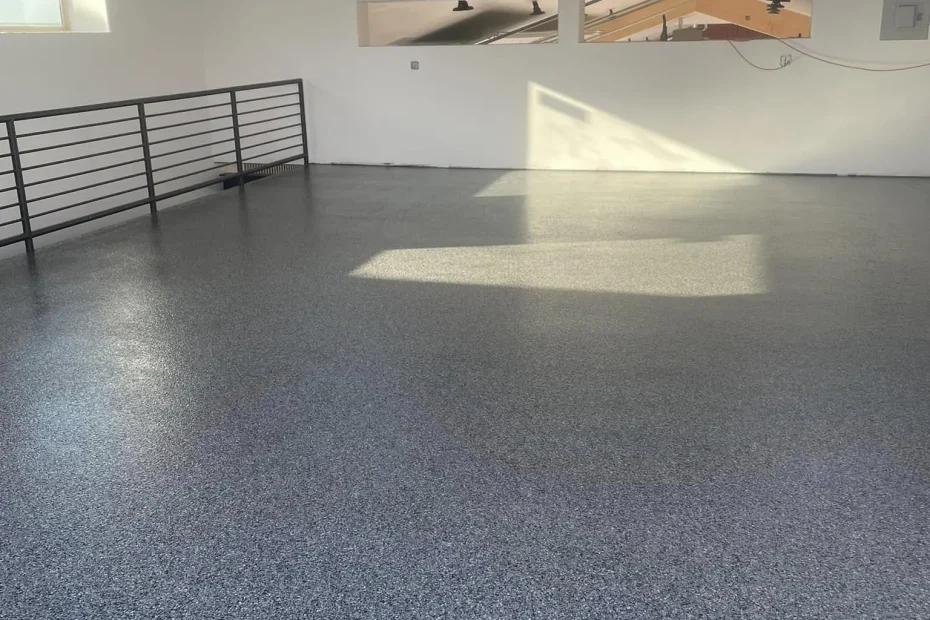
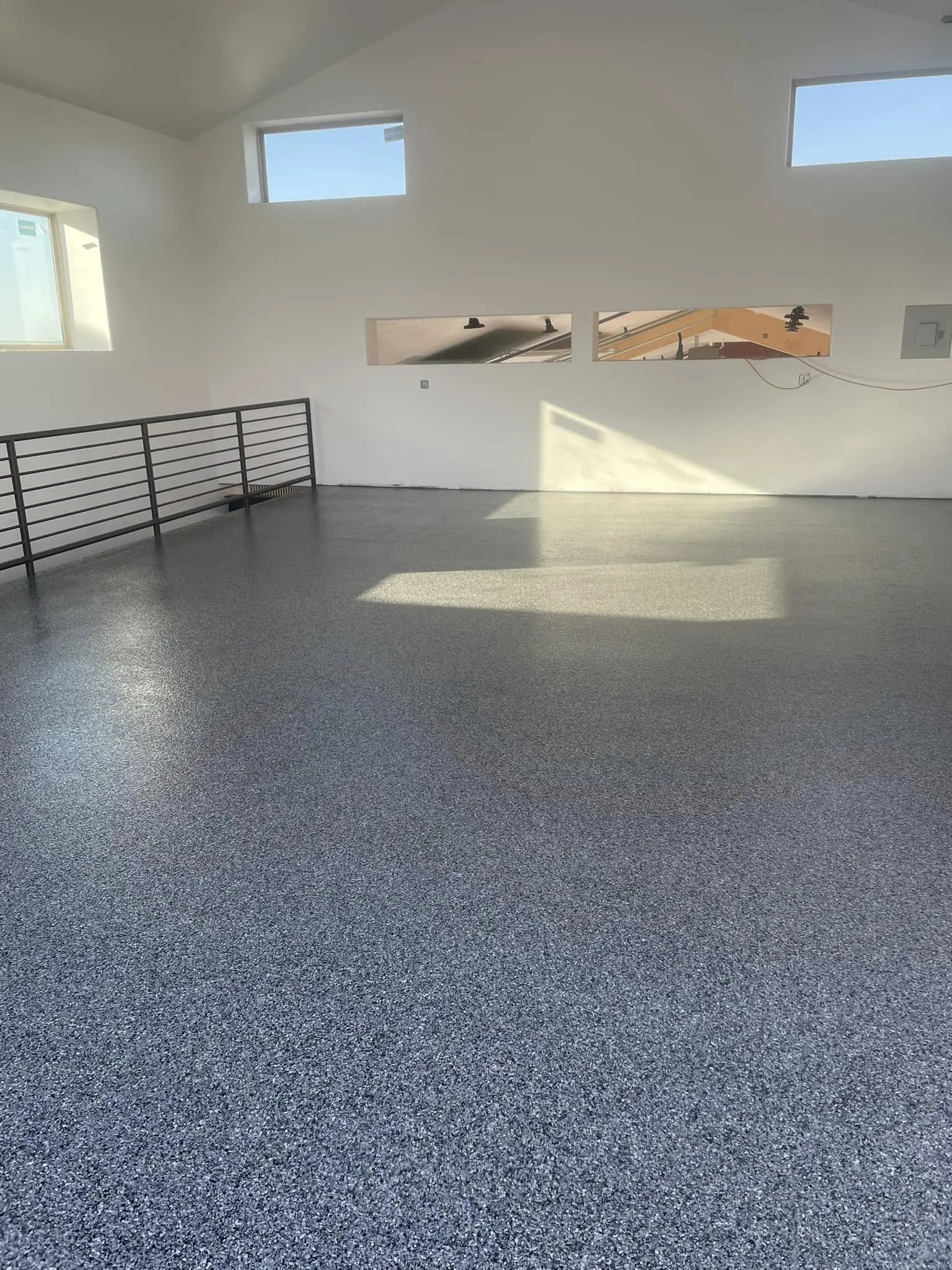
Flake epoxy sits in the standard tier for a Lakewood 2-car garage. Polished concrete is priced per square foot and can come in lower. Flake epoxy wins on garage practicality: UV-stable with polyaspartic topcoat, hides imperfections, same-day drive-in. Polished concrete wins on interior spaces where you want a natural stone look without a coating system on top.
Two Different Products with Overlapping Use Cases
Flake epoxy and polished concrete are not direct substitutes. Flake epoxy adds a coating on top of the concrete. Polished concrete works the concrete itself: mechanical grinding and honing with progressively finer diamond tooling until the surface achieves a reflective, low-maintenance finish. No coating sits on top.
In Lakewood, you’ll see flake epoxy in garages, driveways, and commercial bays. Polished concrete appears more often in retail interiors, restaurant floors, and finished basements where the natural material look is the goal. There are Lakewood garages with polished concrete, but it’s less common because polished surfaces without a topcoat seal can absorb oil stains.
Cost Side by Side
Flake epoxy for a standard Lakewood 2-car garage (400 to 500 sq ft) sits in the standard tier. Polyaspartic topcoat is included in that number, and the per-square-foot cost is set by system spec and prep.
Polished concrete for the same floor is priced per square foot depending on grit level (cream polish vs. full aggregate exposure), stain or dye work, guard/densifier application, and final sealer. A mid-grade polished concrete on a 2-car garage floor is the entry tier for the polish route, while top-tier aggregate-exposed polish with stain and sealer runs meaningfully higher.
On sticker price alone, polished concrete can be cheaper or comparable to flake epoxy. The difference is in what you get.
Durability in Lakewood’s Climate
Lakewood is at 5,430 feet with 300-plus days of sun and freeze-thaw cycles in winter. Both products handle this, but in different ways.
Flake epoxy with polyaspartic topcoat: aliphatic topcoat resists UV yellowing, impervious to oil and chemicals, hot-tire rated, can handle road salt and sand tracked in from Jefferson County winters. The coating protects the concrete underneath from freeze-thaw moisture migration.
Polished concrete: the densified surface is highly durable and UV doesn’t cause color shift (it’s the concrete itself). Freeze-thaw resistance depends on the concrete quality and whether a penetrating guard was applied. Oil and chemical resistance requires regular guard reapplication.
Maintenance Over 10 Years
Flake epoxy maintenance: sweep, occasional damp mop with pH-neutral cleaner, re-apply topcoat every 8 to 15 years depending on traffic and UV exposure. Chips and gouges are repairable with epoxy fill. No ongoing professional maintenance required.
Polished concrete maintenance: regular burnishing (annually or more for commercial spaces), guard reapplication every 2 to 5 years, stain remover on spills before they penetrate. Heavy traffic polished floors need professional re-polishing every 10 to 15 years to maintain sheen. Higher ongoing cost than epoxy for high-traffic spaces.
Which One for Your Lakewood Project
Garage or commercial bay where you park vehicles, work on projects, or store chemicals: flake epoxy with polyaspartic topcoat. The coating seals the surface, hides the texture variations common in older Jefferson County garage slabs, and stands up to everything you’ll put on it.
Finished basement, restaurant, retail, or residential living space where you want the concrete itself as the design element: polished concrete. The natural look doesn’t read as “coated.” Maintenance is manageable with the right guard program.
If you’re genuinely unsure which direction fits your Lakewood project, the on-site look covers both options. We do both.
Lakewood Flooring FAQ
Can I polish my garage concrete after applying epoxy?
No. Polishing works on the concrete substrate. Once epoxy is on top, you’d need to remove the coating first. If you want polished concrete, that decision happens before any coating work.
Does polished concrete get slippery in Lakewood winters?
A smooth polished surface can get slippery when wet. A matte or satin polish (lower grit finish) has more texture. Anti-slip guard products are also available. For Lakewood garages where vehicles come in with snow and slush, flake epoxy with grit broadcast is the safer call.
How long does each system last?
Quality flake epoxy with polyaspartic topcoat: 15 to 25 years before recoat. Polished concrete: the substrate is permanent, but the sheen requires periodic maintenance to maintain. Guard reapplication every 2 to 5 years.
Can you do polished concrete on old concrete?
Yes, but old concrete with extensive cracking, previous coatings, or low quality aggregate may have limitations. We assess the slab during the on-site walk-through. Cream polish (grinding less aggressively) can hide more surface variation. Aggregate-exposed polish shows more of what’s in the slab.
Do you service Lakewood for both flake epoxy and polished concrete?
Yes. We cover Lakewood, Arvada, Golden, Wheat Ridge, and Jefferson County for both coating and polishing work. Most jobs are scheduled within 2 to 4 weeks.
Not Sure Which System Fits Your Lakewood Floor?
The on-site look covers both options. We measure, assess the concrete, and walk through what each system looks like on your actual slab.
Call (720) 635-0282 Schedule a Free Look