Evergreen Metallic Epoxy
Metallic epoxy goes down as a liquid, and the pigment wanders through it until the resin sets, so the pattern never repeats from one room to the next. In Evergreen the room is usually downstairs: a walk-out rec space, a guest room, a lower level that doubles as the gear room. That concrete stays cold for most of the year. A metallic can look great down there, as long as the slab gets tested first and the room stays warm while the floor cures.
Reading a Cold Lower-Level Slab Before the Pour
Lower levels in mountain homes sit partly in the hillside. The slab rests on cold ground, and on a walk-out one wall is usually buried too. Water vapor moves up through that concrete all year. On bare concrete you would never notice. Seal it under a closed film like metallic epoxy and the vapor has nowhere to go, so it pushes. Months later that push shows up as blisters, soft spots, or a patch that lifts off the slab.
Cold makes it harder to judge. Vapor drive through cold concrete is common in these houses, and a slab that feels dry to the hand in January can still be moving moisture. So we grind first, since a reading taken through old sealer or paint tells you very little. Then we take moisture readings across the room, with extra ones along the buried wall, in the corners, and anywhere a stain or a musty smell says water has been.
Metallic is self-leveling, which means it also shows the shape of the floor under it. Dips collect resin and read darker than the rest. We fill and flatten before the pour. When the readings call for a vapor-control primer, it goes under the base coat. When they say no coating belongs on that slab, you hear it from us.
Planning a rec room or guest room downstairs?
Tell us how the room gets used and whether it has a walk-out door. We will drive up, look at the concrete and read it.
Keeping the Room Warm While the Resin Sets
Epoxy hardens through a chemical reaction, and cold slows that reaction way down. A metallic poured in a chilly basement stays soft longer, and the pigment keeps drifting while it waits. Some drift is the whole point. Too much time in the cold can also leave a hazy, blushed surface that stays tacky and collects dust and sock prints before it hardens.
Evergreen has a long freeze season, and a lower-level slab can run well below the air temperature upstairs. So the room gets warmed before we arrive, stays warm during the pour, and stays that way until the floor is hard. The concrete has to come up along with the air, and concrete takes longer. We ask you to leave the heat on and keep outside doors shut, and we check the slab temperature ourselves before anything gets mixed.
Spaces with uneven heat take more planning. If part of the lower level runs cold, or the room depends on a stove that is not lit every day, we work out how to hold the temperature or move the pour to a better week. Pouring into a cold room to keep a date on the calendar is how metallic floors go wrong.
Smoky Silver or Warm Copper Under a Pine Ceiling
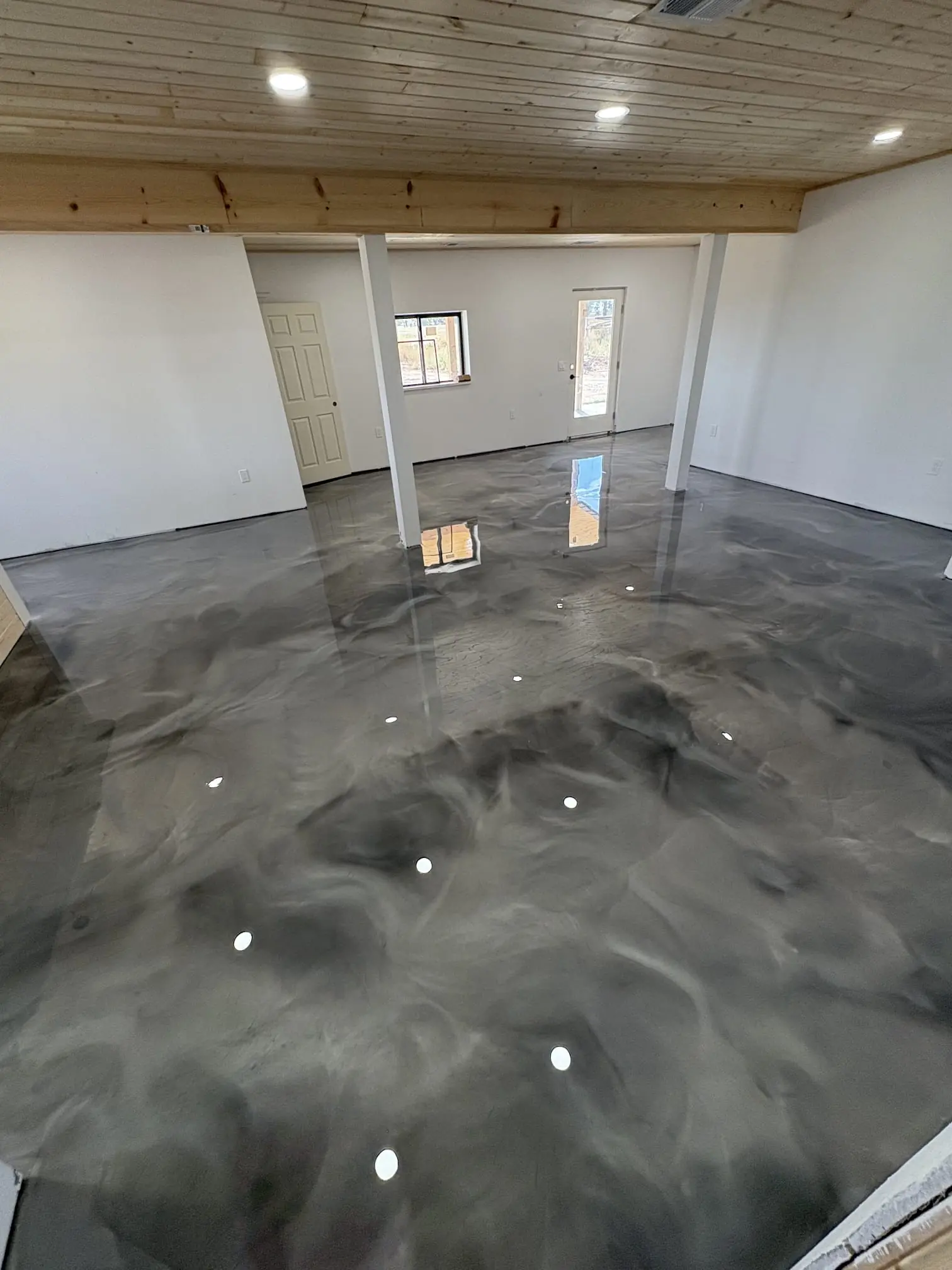
Mountain homes lean on wood: plank ceilings, timber trim, stair rails. The floor has to live with all of it. The photo on this page shows one way to go, a gray and silver metallic under a pine plank ceiling. The cool floor keeps the wood from taking over the room, and the recessed lights stretch out across the gloss.
The pour’s movement shows most where light hits it at an angle. Recessed cans make bright spots. A walk-out door or a low window throws a long sheet of light that picks out every swirl. We lay sample boards on your slab so you can see them under your own ceiling and fixtures, at the hour the room gets used.
Most mountain homeowners plan to keep the house a long time and care more about durability than trend. A color picked to suit the wood usually wears better on the eye than whatever looked newest in a showroom.
Snow Boots, Grit and the Clear Coat on Top
A lower level with a walk-out door turns into the family’s back entrance. Snow boots come in wet, trail gear gets dropped by the door, and grit rides in on all of it. Water does nothing to a sealed pour. A pebble under a boot heel scratches it, and a winter of pebbles leaves a dull path from the door to the stairs.
The layer that takes that traffic is a clear coat. We choose it for abrasion resistance and build it thick enough to be worth recoating later, so the metallic underneath never meets a boot. When the path by the door starts to look tired, the clear layer gets scuffed and recoated. The one rule is to call before it wears through.
Habits do the rest. A mat outside the walk-out and another one inside catch most of the grit. A boot tray keeps meltwater off the gloss. Dust mop often, wipe up puddles, and skip cleaners that leave a film.
The Detached Garage Gets a Different Floor
People who like a metallic downstairs sometimes want the same floor in the garage. For a showroom bay with a car that rarely moves, it can work. The detached garage most Evergreen homes depend on is another story. It holds firewood, snow gear, and trail and lake equipment, and trucks pull in carrying sand and magnesium-chloride road treatment. It swings between sun and shade and cycles through deep freezes. A metallic in there would show every chip of bark and every dried salt ring, and it would be slick underfoot when wet.
For that garage we point people to a flake epoxy system, and our garage coatings page walks through how we build those bays. The landing and steps by the door are a job for a polyaspartic coating. A shop where nothing should ever peel is often better as polished concrete.
Metallic earns its place in a warm, finished room where people spend their evenings. Anywhere rougher, we will steer you to something sturdier before you pay for the wrong floor.
What Evergreen Homeowners Ask About Metallic
Can a metallic floor go on a cold lower-level slab?
Often, once the slab passes a moisture check. Cold concrete set into a hillside can move a lot of vapor, and a sealed metallic traps it. We grind, take readings in several spots, and add a vapor-control primer when the numbers call for one. If the slab fails, we tell you.
Why do you want the heat on before the pour?
Epoxy hardens through a chemical reaction that slows down in the cold. A chilly room can leave the floor soft, hazy or tacky for too long. We ask you to warm the room and the slab ahead of time and keep them warm through the cure, and we check the slab before mixing.
Which colors suit a room with a pine plank ceiling?
Smoky grays and silvers sit calmly against warm wood and let the ceiling stand out. Coppers and bronzes feel warmer at night but can blend into a lot of pine unless a darker base adds contrast. We lay sample boards on your slab under your own lights so you can compare.
Will wet boots and grit ruin the finish?
Water does not hurt a sealed metallic floor. Grit wears it, mostly along the path from the door. The clear topcoat takes that wear, and we choose it for abrasion resistance. Mats inside and out, a boot tray and regular dust mopping slow it down, and a worn clear layer can be recoated.
Does well water residue on the slab cause problems?
It can. Minerals left on bare concrete sit on the surface and keep a coating from bonding to the slab itself. Grinding removes that film along with old sealer and stains. A ring or crust in one spot also tells us water has moved there, so we take an extra reading in it.
Should the detached garage get metallic too?
Usually not. A garage full of firewood and snow gear, with trucks bringing in sand and magnesium chloride, will show every mark on a metallic, and it gets slippery when wet. A flake system hides grit and handles freeze-thaw cycling much better. Save metallic for a finished, heated room.
More Floors We Put Down Around Evergreen
We make the drive up from Parker for work in Evergreen, Bergen Park, Hiwan and Kittredge, from homes around Evergreen Lake to properties up Upper Bear Creek. Metallic is one of five systems we install up here.
Every system we offer up here is on the Evergreen, CO page, and the main metallic epoxy page covers the pour in more depth. Nearby towns sit under Jefferson County. Finished floors are in the gallery. To talk through a room, drop us a line or call (720) 635-0282.