Highlands Ranch Garage Coatings
The garages in Highlands Ranch tend to be big, often three cars wide, and they do a lot more than park vehicles. They store the trail bikes, the ski gear, the kayaks, and the overflow from the house, and the bare concrete underneath takes the road salt off C-470, the summer heat, and the freeze-thaw that comes with living at the edge of the foothills. Elevated Epoxy Co installs garage floor coatings across Highlands Ranch that stand up to all of it, look sharp for 15 years and more, and go down in a single day for most residential garages.
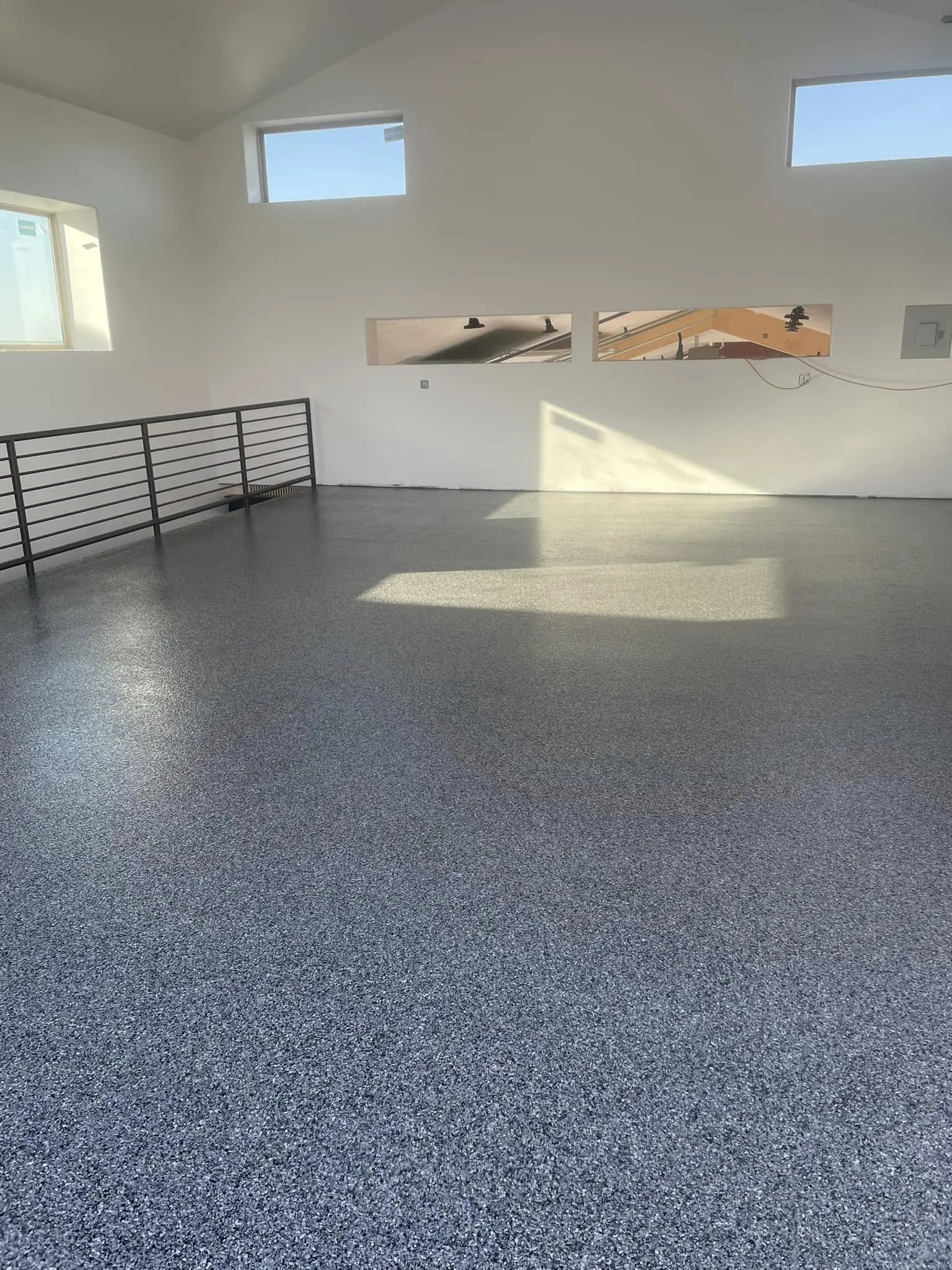
The Garage Floor System We Build in Highlands Ranch
Our standard Highlands Ranch garage build is a four-step system: a 100-percent-solids epoxy primer that bonds into the concrete, a full broadcast of vinyl flake, a polyaspartic topcoat, and a slip-resistant final pass. The finished floor runs about 25 to 30 mils thick. The flake layer hides the small imperfections in the slab, the polyaspartic shrugs off hot-tire pickup and chemical spills, and the slip texture keeps the floor safe when a car pulls in dripping snowmelt in January. It is a floor built to be used hard, not babied.
What separates a floor that lasts from one that peels is the preparation, and that is where the cut-rate crews cut corners. We diamond-grind every Highlands Ranch slab with 30-grit metal-bond pads to open up clean aggregate, vacuum to HEPA spec so no dust contaminates the bond, fill cracks and control joints with polyurea, and only spot-etch where the grinder cannot reach. Skipping or rushing prep is exactly what causes the bubbling, peeling, and delamination you see six to twenty-four months after a bargain install. We photograph every prep stage so you can see the work that goes in under the finish.
What a Highlands Ranch Garage Floor Is Up Against
A garage floor here lives a harder life than most people give it credit for, and understanding that is why we spec the way we do. Every winter, cars come home from C-470 and Santa Fe carrying magnesium chloride de-icer, and that brine drips onto the slab and sits. On bare or painted concrete it soaks in, corrodes the surface, and works into hairline cracks where the freeze-thaw cycle then pries them wider. A sealed polyaspartic floor gives the salt nothing to soak into: it beads on the surface and mops away. Add the daily temperature swings a Highlands Ranch garage sees, warm afternoon sun through an open door, deep cold overnight, and you have a slab that is constantly expanding and contracting, which is exactly the movement a rigid budget coating cannot flex with.
Hot-tire pickup is the other everyday assault. Tires coming off a summer highway run hot and soft, and as they cool against a cheap coating they grip and peel it up in patches, the classic failure of a big-box DIY kit. Our commercial-grade polyaspartic is tire-rated, so a set of hot tires parks on it every day for years without lifting a thing. Between the salt, the freeze-thaw, and the hot tires, a Highlands Ranch garage floor needs a real system, not a paint job, and that is the whole reason a properly built floor is worth what it costs.
Which System Is Right for Your Garage
We install three garage systems, and the right one depends on how you use the space. Full-broadcast flake with a polyaspartic topcoat is the workhorse and the one most Highlands Ranch homeowners choose: durable, great at hiding slab marks and the daily grime of a working garage, and available in neutral blends that keep resale appeal broad. A solid-color epoxy under polyaspartic gives a cleaner, more industrial look for the owner who wants a uniform surface with no speckle, and it runs a little below flake since there is no chip material. Metallic epoxy under polyaspartic is the showpiece for a garage that doubles as a display space, a car collector’s bay or a finished multi-use room, and it carries roughly a 30 to 40 percent premium over flake.
The choice usually comes down to two questions: how much you want the floor to hide, and how much you want it to show off. A daily-driver family garage full of gear leans flake. A minimalist, uniform look leans solid color. A garage meant to impress leans metallic. We bring sample boards for all three to the on-site visit so you make the call in person, in your own light, rather than off a screen.
Color and Finish Options for the Neighborhood
Most Highlands Ranch homeowners choose neutral flake blends, warm grays and browns that photograph well and keep resale appeal, since a lot of these homes eventually change hands. Bolder custom blends with copper, slate, or blue show up in personalized showcase garages. If you want an industrial look, a solid-color epoxy with no flake is on the table. And for the homeowner turning a garage into a showpiece, metallic epoxy under a polyaspartic topcoat is the high-end option, running roughly 30 to 40 percent above the standard flake system. We bring sample boards to every quote so the color decision is made in person.
What Install Day Looks Like
Most single-bay Highlands Ranch garages are a one-day install. A two-car runs one to one-and-a-half days, and a three-car or oversized garage with a workshop bay runs a day and a half to two. Foot traffic is fine 24 hours after the final coat, and vehicles can return after 72 hours. We watch the forecast closely, since Colorado can throw a spring snow event that pushes a start, and we coordinate the garage clear-out with you three days ahead so the space is empty and ready when the crew arrives. The dry, high-altitude air here actually helps our coatings cure a touch faster than they would down in a humid climate.
Ready for Highlands Ranch garage floor coatings?
Call us, send a message, or browse our gallery to see real Douglas County projects.
Highlands Ranch Garage Coatings FAQ
Highlands Ranch Garage Coating FAQ: What does it cost?
A standard flake-and-polyaspartic two-car Highlands Ranch garage is priced by the floor plan and the condition of the slab. Metallic adds 30 to 40 percent. Three-car garages, which are common here, scale up from there. Quotes come with an on-site measurement.
Highlands Ranch Garage Coating FAQ: Will it crack in our cold winters?
The polyaspartic topcoat handles Colorado temperature swings well below zero. Cracks come from the concrete moving, not from the coating failing. We fill any pre-existing slab cracks with polyurea before coating so they do not telegraph through the finish.
Highlands Ranch Garage Coating FAQ: Will hot tires lift the coating?
No. Our polyaspartic topcoats are tire-rated for daily-driver use, so a set of hot tires coming off C-470 on a summer afternoon will not pull the coating up. The cheap big-box DIY kits are the ones that fail on hot tires; commercial-grade polyaspartic does not.
Highlands Ranch Garage Coating FAQ: How soon can I drive on it?
Foot traffic is fine 24 hours after the final coat, and vehicle traffic after 72 hours. The dry Highlands Ranch climate cures faster than humid regions, but we still recommend the full 72 hours before the first vehicle comes back in.
Highlands Ranch Garage Coating FAQ: Do I have to empty the garage?
Yes. The garage needs to be clear for grinding and coating. Most homeowners stage the contents in the driveway on a pod or tarp, and we can point you to a local moving service if you would rather not handle it yourself.
Highlands Ranch Garage Coating FAQ: What exactly does the warranty cover?
Our residential garage floors carry a long-term material-and-labor warranty against adhesion failure, peeling, delamination, and hot-tire lift. It covers the coating doing its job. It does not cover physical impact damage, cuts from dropped tools, or new cracks that come from the concrete slab itself moving, since a coating cannot stop a structural slab from shifting. We put the terms in writing on the itemized quote so you know precisely what is and is not covered before we start.
Other Highlands Ranch Epoxy Flooring Services
View all Highlands Ranch, CO services · See our work · Elevate My Floor
Service Area: Highlands Ranch, CO
We serve all of Highlands Ranch, CO and surrounding Douglas County neighborhoods.