
A roof over a porch still lets low morning and evening sun reach the floor, and UV at this elevation is strong enough to yellow ordinary epoxy. Outdoor concrete here also swings from hot afternoons to cold nights. A UV-stable, slightly flexible polyaspartic topcoat over a flake broadcast handles both, provided the slab, the steps and the edges are ground properly and the color is chosen for heat and dust.
A roof overhead still lets the sun in
Custom homes in Roxborough Park tend to face the views, and the views here are red sandstone, open space and the hogback. That orientation puts covered decks, front porches and entry slabs right in the path of the sun for much of the day.
A roof blocks rain and the high midday sun. It does nothing about low morning or late-afternoon light, which slides in under the eave and sits on the floor for hours. Bright light at this elevation also bounces off pale stone and siding, so even the shaded part of a covered patio takes more UV than most people expect.
Bare concrete out there has a hard life. It stains from leaves and planters, turns dusty, and holds onto the granite grit that blows across it. Plenty of owners paint it, and porch paint tends to peel first at the doorway and along the steps, right where everyone walks.
Sealing the slab takes care of the dust and the stains. The harder part is picking a coating that can live in outdoor light.
Why ordinary epoxy fades outside
Most epoxy resins are sensitive to ultraviolet light. Outdoors they chalk and turn amber, and a gray floor goes yellowish in its sunniest strip first. Indoors that shift is slow and easy to miss. On a sunny porch it becomes obvious.
Polyaspartic is what we use on exterior slabs. It is a close relative of polyurea, and good formulations are UV-stable, so the clear coat stays clear and the color below keeps its tone. It also cures quickly, which helps outdoors, where wind-blown dust and bugs get less time to land in wet coating.
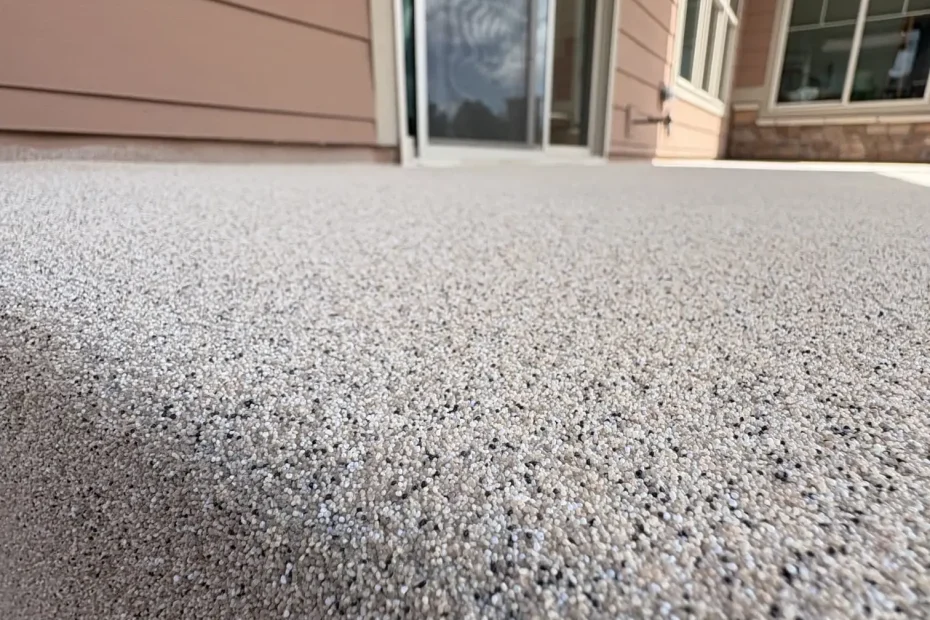
The usual outdoor build is primer, a flake broadcast for color and texture, and a polyaspartic clear coat to lock it all down. The covered deck in the photo below carries a gray coating that sits comfortably next to stacked stone and a white railing.
You can read how we put these systems together on our Roxborough Park polyaspartic coatings page. If you want more pattern in the chips, the flake epoxy page shows a wider range of blends.

Warm afternoons, cold nights and a slab that moves
The elevation here drives big daily temperature swings. An outdoor slab can bake through the afternoon and then cool hard after dark. Concrete expands and contracts through every one of those cycles, and whatever sits on top has to move along with it.
Thick, brittle coatings struggle with that. They build stress with each swing until they crack over joints or let go at the edges. Polyaspartic stays slightly flexible once cured, so it tolerates the movement far better than a rigid film does.
Temperature also rules the install day. Outdoor concrete heats up quickly, and coating a hot slab in full sun shortens working time and can trap tiny bubbles as air escapes the concrete. We schedule exterior work for a stretch of the day when the slab is shaded or cool, and we measure surface temperature rather than trusting the air reading before anything gets mixed.
Overnight dew and recent snow get checked the same way. A slab that looks dry on top after a cold night can still hold moisture just below the surface, and primer laid over it will not bond the way it should.
Steps, edges and the doorway take the worst of it
On a porch or covered deck, failures start in predictable places. The front lip of the slab and the steps catch weather the roof misses. The threshold at the slider takes every footstep in and out. Posts and railing bases break the surface into tight corners where coatings are hardest to apply evenly.
Prep takes care of most of this. We diamond grind the whole slab, steps and nosing included, so the primer has open concrete to bond to everywhere. Old porch paint comes off completely. Cracks get filled, and control joints get cleaned and filled with polyurea so water has nowhere to sit.
At the edges we carry the coating over the lip of the slab wherever it can be done cleanly, which keeps water from working in behind the film. Around posts we detail by hand, since a roller leaves thin spots in corners.
The low view at the top of this post shows why the edges deserve that care. The border of a patio beside a sliding door is exactly where your eye lands every time you step outside.
Color and footing for a floor people walk barefoot
Choosing color outdoors comes down to heat, dirt and what surrounds the slab.
Light and mid grays stay cooler underfoot in sun than dark blends, and they hide the fine granite dust that settles on a porch. They also sit well against tan siding, stacked stone and sandstone views. A very dark flake looks rich but soaks up heat and shows every dusty footprint.
Sheen matters as well. Most owners keep an outdoor floor at a satin level, because high gloss throws glare when the sun is low.
Footing counts for more outside than it does in a garage. The flake chips add some texture on their own. On stairs, entries and anywhere rain or blown snow reaches, we add a fine grit to the topcoat for more grip. It takes a little shine off and makes the surface much safer in wet shoes.
If the front entry leads into a coated garage, you can match the two or choose a related blend a shade lighter for the porch. Our garage coatings page shows the systems we build indoors.
Outdoor coating questions
Does a coated porch get too hot to walk on barefoot?
Any surface in direct sun warms up, and a coating runs about as warm as the concrete underneath it. Color makes the biggest difference, since light and mid gray blends stay noticeably cooler than dark ones. On a covered deck the roof shades most of the slab at midday, so the warmest strip is usually the outer edge that catches low sun.
Is a coated covered deck slippery when it rains or snows?
A smooth clear coat can be slick with water on it. Outdoor floors get a fine grit mixed into the topcoat, with extra attention on the steps and the threshold at the door, and the flake adds texture of its own. The finished surface sweeps and hoses clean while still giving wet shoes something to grip.
Should the front porch match the garage floor?
It can, and many owners like that continuity. Others choose a lighter blend for the porch because it stays cooler in sun and shows less dust, while the garage takes a darker mix that hides tire marks. We lay samples on both surfaces during the walkthrough so you can compare them in the light each space actually gets.
An outdoor slab here asks a lot of a coating: strong sun, big temperature swings, grit and weather at the edges. Picked and prepped for those conditions, a coated porch or covered deck stays good looking and easy to keep clean.
Sun Beating on the Porch Floor?
We look at where the light lands, check the edges and steps, and help you pick a blend that holds its color outdoors.
Call (720) 635-0282 Request a Free LookRoxborough Park Polyaspartic Coatings · See outdoor floors · Roxborough Park services · Request a free look