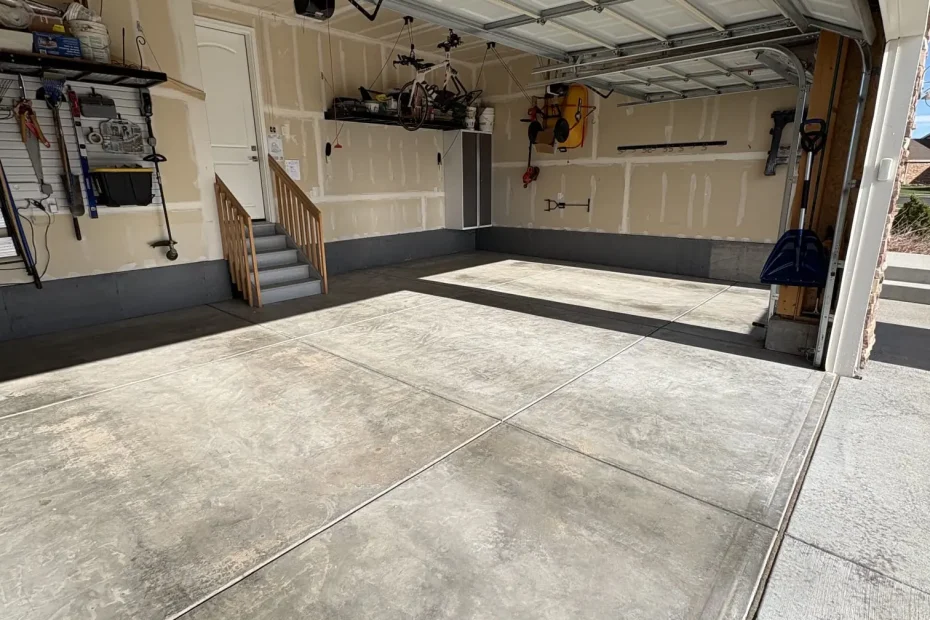

The white and tan blooms on a garage slab fed by well water are dried minerals packed into the pores of the concrete. They look like a cleaning problem and behave like a bonding problem, because primer grabs the crust instead of the slab. Diamond grinding removes that contaminated layer along with oil and old coatings, and once the floor is sealed, hard-water spots sit on top where they wipe away.
Where the white crust comes from
Where a Roxborough Park home runs on well water, the garage slab usually shows it first. Water from a hose, a driveway car wash, a softener line or a utility sink lands on the concrete and soaks in. As it dries, the dissolved minerals stay behind. The result is white or tan blooms, rings where buckets sat, and a chalky film that returns however often you sweep.
Concrete is porous, so the residue lives inside the surface as well as on it. The top of the slab fills with deposits the way the inside of a kettle does. Scrub it and the floor looks better for a day, then the white creeps back as moisture wicks more of it up from below.
None of this hurts the slab structurally. It turns into a real problem the day someone decides to coat the floor, because every system we install depends on resin soaking into clean, open pores. A mineral-packed surface has very few open pores left to take it.
Minerals sit between the primer and the concrete
An epoxy or polyaspartic primer works by wicking into the concrete and locking on as it cures. That mechanical grip is the entire bond. Roll it over a crust of dried minerals and it grabs the crust instead. The crust is only loosely attached to the slab, so the whole coating ends up as strong as that chalky layer and no stronger.
Failure from this has a recognizable pattern. Small spots lift first, often where water collected most: the low corner near the drain, or the patch under the car where snow drips. Hot tires then pull at those weak spots and the peel spreads outward. People blame the product. Usually the product was fine and the surface under it was the weak link.
Mineral salts can also keep moving. Ground moisture rising through a slab carries more of them toward the top, where they can push against the underside of a film. That is one more reason we moisture test a garage before primer, even a garage that looks bone dry. The reading tells us whether the salts are done traveling.
Oil, tire marks and the stains that ride along
Mineral residue rarely shows up alone. A three-car or oversized garage has usually collected oil drips, tire marks from hot rubber, rust rings from a toolbox, and sometimes a layer of garage paint or sealer from a previous owner.
Each one gets handled its own way. Tire marks and surface grime come off during the grind. Oil is the stubborn one, because it soaks deep and resin refuses to bond to concrete that is still oily underneath. Heavy spots get degreased and ground again, sometimes more than once, until the concrete comes up dry and gray. Old paint or a failing DIY coating comes off entirely.
Cracks and control joints get cleaned out and filled with polyurea at this stage. Mineral deposits pack those joints just like the surface, so they get routed open first.
By the time prep is finished, a badly stained slab and a clean one look about the same to the primer. Whatever discoloration you can still see is color in the concrete, and color in the concrete does no harm at all.

How far the grinder has to go
Diamond grinding is the step that turns this slab into something a coating can hold. The grinder cuts away the top of the concrete, taking the mineral-filled surface with it, and leaves an open profile full of fresh pores.
How deep we go depends on what the slab shows. A light bloom may clear with a standard pass. Heavy crusting around a softener or sink area can take several passes with coarser diamonds before the white stops appearing. We check by wetting a section: clean concrete darkens evenly and drinks the water, while contaminated patches bead up or stay pale.
Dust goes into a vacuum hooked to the grinder, which matters in a garage attached to the house. After grinding, the whole floor gets vacuumed again, since leftover powder is its own bond breaker.
Then comes primer and the build. On most garages here that means a flake broadcast locked down with a polyaspartic topcoat, the system laid out on our Roxborough Park garage coatings page. A typical two- or three-car garage here finishes in one to two days.
Living with well water on the finished floor
A coated floor changes the whole problem. Water can no longer soak in, so the minerals have nowhere to hide. They dry on top as spots, and a spot sitting on top wipes off.
The easy routine is to squeegee standing water toward the drain or out the door after washing a car, rather than letting puddles evaporate in place. A mop with a pH-neutral cleaner handles the rest. Skip acidic tile cleaners and harsh solvents, which the topcoat does not need.
Flake color helps as well. A blend with some light and some mid-tone chips hides water spots between cleanings far better than a solid dark color, and high-gloss black shows them worst of all. If you already know the garage sees a lot of hose water, mention it at the walkthrough so the blend from our flake epoxy lineup gets picked with that in mind.
If the softener lives in the garage, a small tray under it keeps salty drips off the coating entirely.
What garage owners on well water ask
Can an acid wash remove the minerals so you can skip grinding?
Acid etching dissolves some surface deposits, but it leaves an uneven profile plus residue that has to be neutralized and rinsed, which puts even more water on the slab. On a floor already loaded with minerals it rarely reaches deep enough. We grind every garage we coat, because grinding removes the contaminated layer outright and leaves a consistent surface for primer.
Will old stains show through a flake floor?
No. A full flake broadcast covers the slab completely, so oil shadows and mineral marks disappear under the chips. What matters is that the stains are clean before primer goes down, since oil left in the pores can stop the bond. Discoloration in the concrete is harmless. Contamination still sitting in it is what we grind and degrease out.
What is the best way to clean a coated garage floor on well water?
Squeegee puddles away before they dry, then mop with warm water and a pH-neutral cleaner. Any white spots that do dry on the surface come off with a damp microfiber cloth. Avoid acid-based cleaners and abrasive scrub pads. If your hose water is especially hard, a last pass with a dry mop keeps new spots from forming in the first place.
Treat mineral residue at the grind and it stops mattering. Leave it in the pores and it decides how the coating performs. If your slab is showing white bloom, we will look at it and talk through the prep before anything gets quoted.
White Stains Come Off Before Anything Goes Down
We look at the slab, test for moisture, and show you how much grinding it needs before any coating goes down.
Call (720) 635-0282 Request a Free LookRoxborough Park Garage Coatings · See coated garages · Roxborough Park services · Request a free look