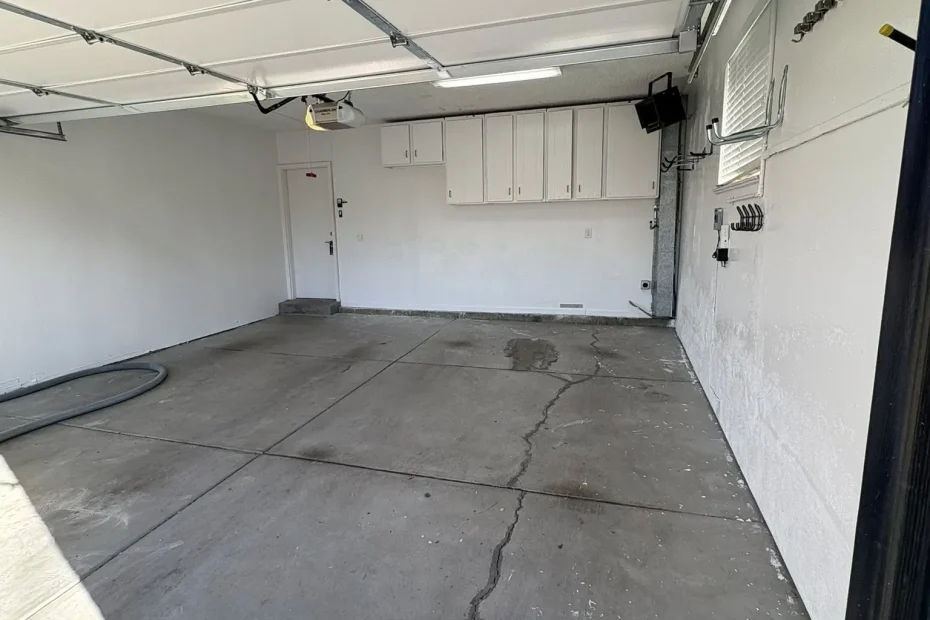
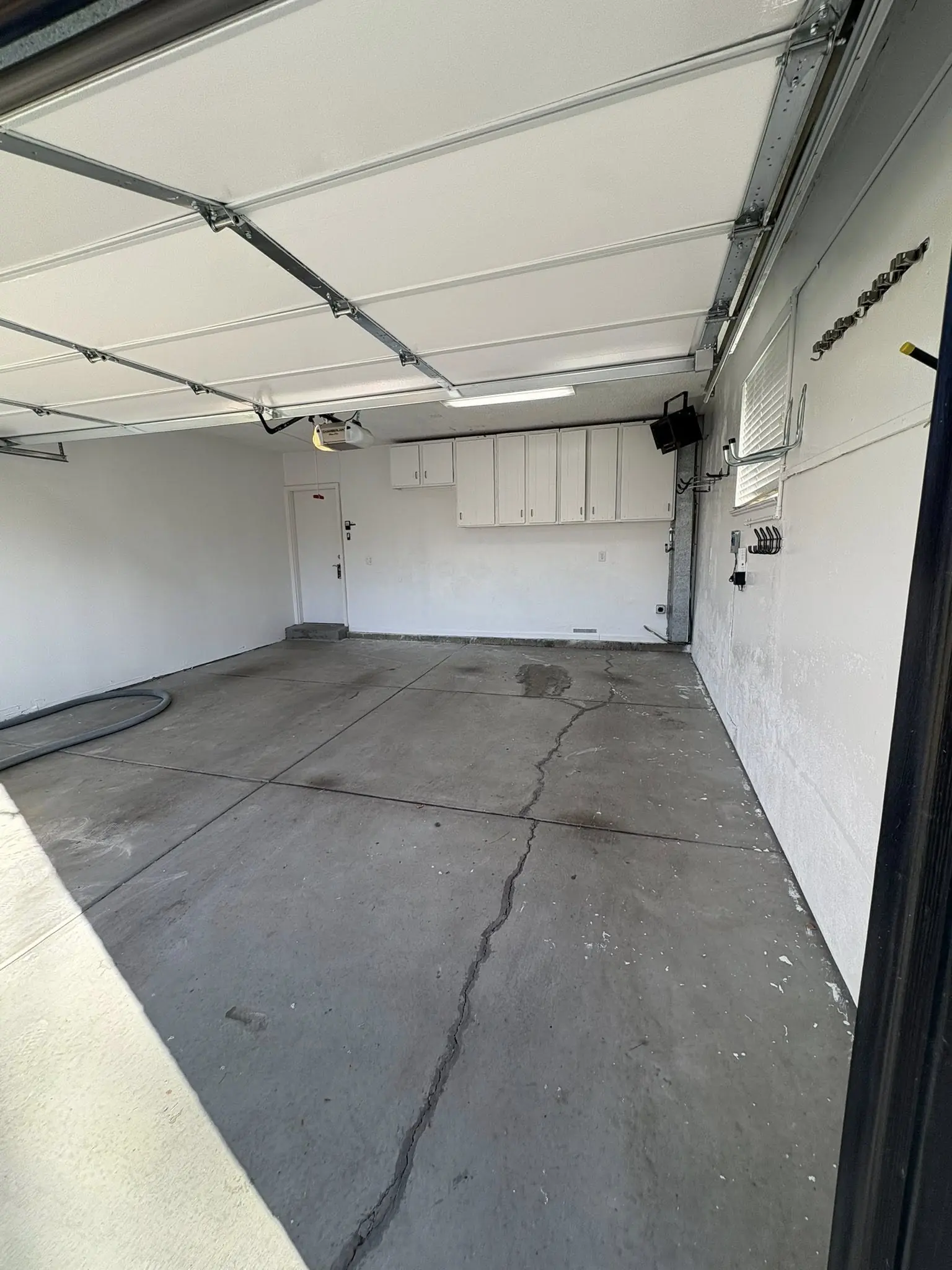
Every crack and joint in a garage slab is a line a coating has to cross. Open ones collect meltwater that freezes and pushes at the film, and untreated ones show through as a groove or a thin ghost line. Chasing each crack, filling it with polyurea and grinding it flush hides most of that. A crack that is still moving can come back, and a busy flake blend is the most forgiving cover for old repairs.
Joints are planned, cracks are not
Concrete shrinks as it dries, and it will crack wherever it wants unless someone tells it where to go. Control joints are those instructions: straight saw cuts or tooled grooves that give the slab a weak line to break along, out of sight.
Cracks happen anyway. A long one running from the door toward the back wall, like the slab at the top of this post, is common in a two-car garage. So are short corner cracks near a drain, a step or a post.
Cold-pour lines are a third kind. When a slab went down in more than one batch, or a section was added years after the first pour, the seam between old and new concrete never fully knits together. Properties that grew a shop or a garage bay over time tend to have them.
All three split the surface into pieces that shift a little on their own as the slab warms and cools. A coating laid across those lines has to deal with that movement, and how each one is treated decides what you end up seeing on the finished floor.
How an open joint telegraphs through
Telegraphing is the trade word for a line under a coating that shows up on top. Roll a coating straight over an open joint and it sags into the groove, leaving a dip that catches dirt and light. Roll it over a hairline crack and the line often reappears within a season, because the concrete underneath kept moving.
Evergreen’s long freeze season adds water to the problem. Snow drips off a truck, meltwater runs into any joint that is still open, and overnight it freezes and expands. That pries at the coating edge along the joint, a little more each cycle, until a strip of film lifts.
Road sand settles in open joints too. Every tire that rolls across grinds that grit into the thin edge of the coating.
Closing the joints keeps water and grit away from the one place a coating is thinnest and most exposed. The cleaner look that comes with it is a bonus.
How polyurea fill works
After the diamond grind, we open each crack with a chasing blade so the filler has clean, sound walls to bond to. Loose edges and old caulk come out. Then everything gets vacuumed, since dust left in a crack acts like a gap.
We fill with polyurea. It flows into the crack, grabs both sides, and hardens quickly, which lets us shave it and keep grinding on the same day. Epoxy crack fillers work as well, though polyurea sets faster and stays a touch more forgiving as the slab moves through temperature swings.
Each crack is filled slightly proud of the surface, then cut and ground level with the concrete around it. Run a hand across a finished repair and you should not be able to find the edge.
Wide joints with crumbled, spalled edges get rebuilt before they are filled, because a repair sitting on broken concrete has nothing solid to grip. Our Evergreen garage coatings page shows where joint repair fits into the full garage build, from grind to topcoat.
What can be hidden and what cannot
A filled, ground crack disappears well under a flake broadcast. Chips land across the repair the same way they land everywhere else, and the eye has no line to follow. The finished floor in the photo below uses a black, gray and white blend, and a busy mix like that covers old repairs better than anything else we install.
Solid colors and single tinted coats are less forgiving. A strip of polyurea next to aged concrete has a different color and texture, and a thin coat can let that difference show as a faint shape in low light.
Control joints are a choice. Some owners want them filled and gone. Others keep the joint lines and let the coating follow them into the groove, which gives a large slab a planned place to move.
The hard limit is an active crack, one that grows wider season after season or has one side sitting higher than the other. Fill can hide it for a while. The slab will open that line again eventually, and no coating can hold together concrete that is still shifting underneath it.

Cracks on a floor that stays bare concrete
Polished concrete treats cracks differently, because there is no film on top to hide anything. What you see in the slab is what you get in the finished floor.
We still fill cracks and cold-pour seams before polishing, usually with a filler tinted close to the concrete. The repair ends up flush and sealed so dirt and water stay out, but it remains visible as a line. Plenty of owners like that in a shop or basement, since the floor reads as real concrete with its history left in it.
If a long crack across the middle of a garage bothers you, a coating is the better route. If you want a floor with nothing on top that could ever peel, and a few honest lines do not bother you, polishing deserves a look. Our concrete polishing page covers how the grind stages and densifier work.
Whichever finish you choose, the cracks get handled before it goes down. Skipping that step is how a new floor ends up with a fresh line through it by its second winter.
Crack and joint questions
Will the crack in my garage floor come back after coating?
A crack that has stopped moving, filled with polyurea and ground flush, usually stays hidden under a flake coating. A crack that keeps widening from season to season can reopen as a thin line. We look at the edges, check for a height difference across the crack, and tell you which kind you have before any work starts.
Should control joints be filled or left open?
Filling gives the cleanest look and keeps meltwater and grit out. Keeping the joint lines visible, with the coating carried down into them, gives the slab a planned place to move, which some owners prefer in a big shop. Both are sound choices. An open joint left raw under a coating is the one option we avoid.
Does the seam between old and new concrete show through?
Under a flake broadcast it rarely does, since the primer and chips cover the color change completely. Under a solid tinted coat or a polished finish, the difference in the concrete can still read faintly. We grind across the seam, fill it, and lay samples right over the joint so you can judge before choosing a finish.
Crack and joint fill is part of the prep on every garage floor we coat, so the visit includes walking each line on your slab with you.
Long Crack Across the Garage?
Book a visit and we will check whether that line has stopped moving and how well it can be hidden.
Call (720) 635-0282 Request a Free LookEvergreen Flake Epoxy · See finished floors · Evergreen services · Request a free look