

Shops and businesses near the lake, along Highway 74 and in Bergen Park get snowmelt, grit and heavy foot traffic on the same floor for months, then a busy stretch with little room to close. A slip-textured flake system or a polished slab handles that wear. Planning the work in sections, after hours or during the slower weeks, keeps the doors open while the floor gets done.
What a winter of wet boots does to a shop floor
A business near Evergreen Lake or on Highway 74 sees customers walk straight in from snow, slush and sanded parking lots. Every one of them carries some of it over the threshold.
The first stretch inside the door takes most of that load. Meltwater pools, sand gets ground into the surface, and brine from treated sidewalks dries as a white film. On worn vinyl or bare concrete, the entry zone looks tired long before the rest of the room does.
Wet floors are a safety matter too. A smooth, glossy surface with a film of water on it is where people slip, and the entry is exactly where the water collects.
Behind the counter the problems change. Service bays, stockrooms and workshops take carts, pallet jacks, dropped tools and spilled fluids. A finish that suits the sales floor may not last in the back room, so plenty of commercial jobs end up with two systems under one roof, each picked for what crosses it.
Grip and wear at the front door
For entries and sales floors that take winter traffic, we lean toward a flake broadcast with a clear topcoat and a slip-resistant additive mixed in. The chips add texture of their own, and the additive gives wet soles something to hold.
Texture is a trade-off. More grit means better footing and slightly more effort with the mop. We usually put the heavier texture at entries, ramps and anywhere water gathers, then ease off toward the middle of the room.
Blend choice follows the dirt. Grays and tans with a few darker chips hide sand and salt haze between cleanings, which matters when staff are mopping around customers all day long.
Mats still belong at the door. A coated floor under a good walk-off mat stays cleaner, and the mat gives staff one spot to shake sand out. Where the coating meets a metal threshold, we finish a clean, tight edge so nothing catches a toe or a cart wheel. Our Evergreen flake epoxy page shows how the broadcast system is built.
Bays, shops and back rooms
Service bays and workshops need a floor built for vehicles and equipment. The bay at the top of this post shows a light gray flake floor with a red safety line across it, under steel roof trusses. A light floor like that brightens a big space, and painted lines keep traffic lanes and work zones clear.
Bay floors take hot tires, floor jacks, oil and whatever road treatment the trucks carry in from the highway. A thicker build with a chemical-resistant topcoat holds up much better there than a thin decorative coat.
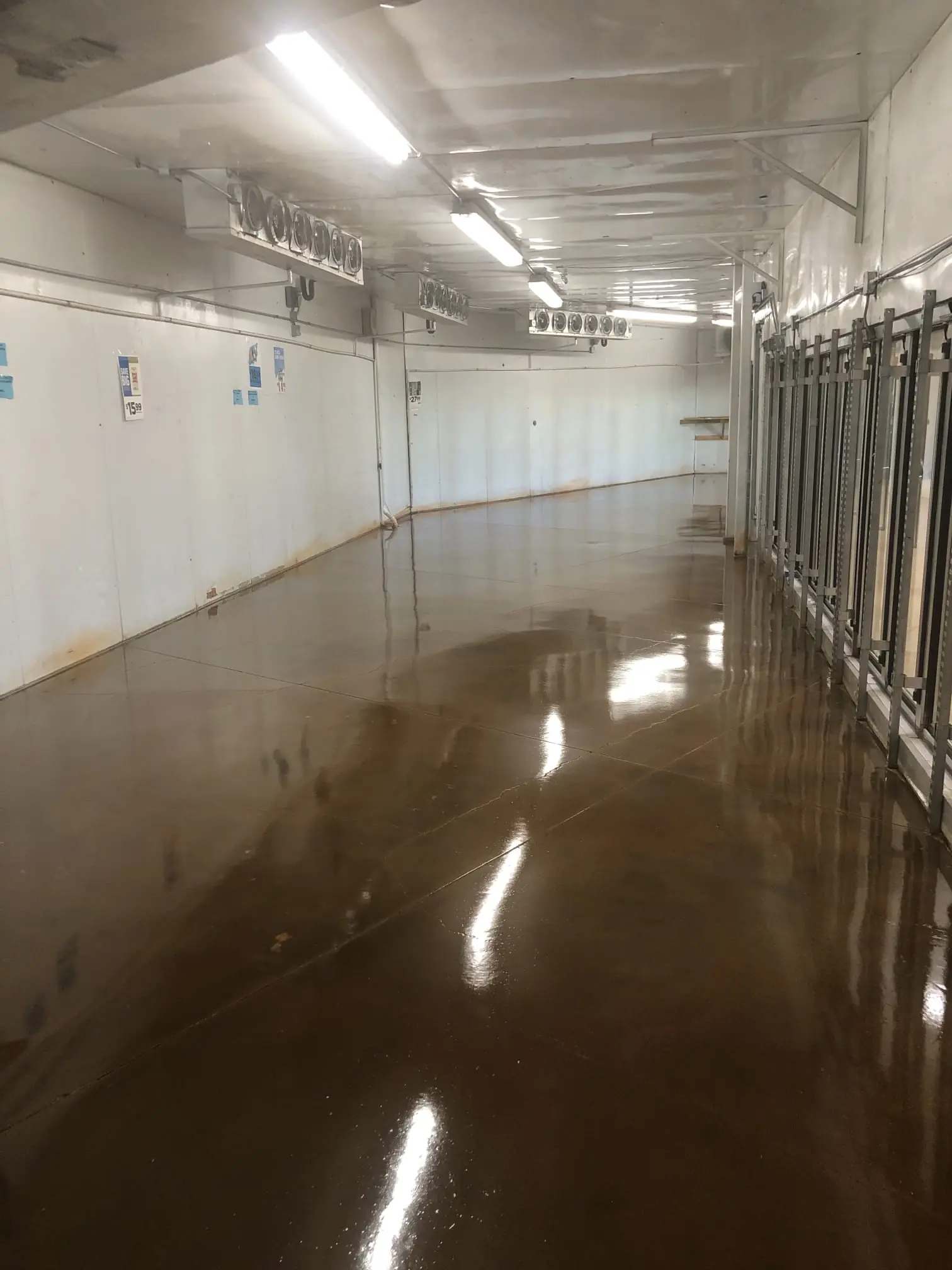
Stockrooms and long back rooms wear differently, since carts and racks do the damage instead of tires. The dark brown high-gloss floor in the photo below runs the length of a white room with metal racks down one wall, and a smooth surface that mops quickly suits that kind of space.
Rack feet and pallet jacks put heavy loads on small points. Tell us what rolls across the floor and what sits on it, so the build thickness in those areas gets planned from the start.
Polished concrete for stores that want no coating
Some businesses would rather skip a coating entirely. Polished concrete fits that preference: the slab is ground, densified and honed, and the finished floor has no film to scratch through or peel.
A polished floor takes foot traffic well and sweeps fast. The densifier hardens the surface, which helps it stand up to the scouring effect of sand. At a low to medium sheen it hides wear and suits a shop or gallery look.
Water is the watch point. Polished concrete is not especially grippy when wet, so entries need mats and a steady cleaning routine, and brine should be mopped up before it dries. Some owners polish the main floor and coat the entry and back rooms.
Polishing also depends on the slab underneath. Old tile adhesive marks, patches and cracks stay visible, which can look great in a rustic space and less so in a crisp retail room. Our Evergreen concrete polishing page covers the grind levels and sheen options in more detail.
Scheduling around a seasonal mountain economy
Business in a mountain town comes in waves. Nobody wants to close for days during the busy stretch, so the schedule matters as much as the system chosen.
We plan commercial work around your hours. Smaller shops can often be finished during a short planned closure. Larger spaces get split into sections, so one area is worked while the rest stays open, with the entry saved for the quietest hours.
Fast-curing polyaspartic topcoats help here. They take foot traffic much sooner than standard epoxy, which shortens how long each section stays roped off. Polishing needs no cure time at all once the grinding is done, though it is louder and takes more hours on site.
The slower weeks between busy seasons are the easiest to book, and the drive up from Parker is simple to plan around. Bring your calendar to the walkthrough and we will lay out a work sequence that fits it. For the full list of systems we install locally, start at our Evergreen services page.
Commercial floor questions
Can you coat our shop floor without closing for a week?
Usually, yes. Smaller spaces can often be finished during a short planned closure, and larger ones are split into sections so part of the business stays open. Fast-curing polyaspartic topcoats shorten the time each section is off limits. We plan the order around your busiest hours and do the entry when traffic is lightest.
How slippery is a coated commercial floor in winter?
A smooth, glossy coat can be slick with meltwater on it. Commercial floors get a slip-resistant additive in the topcoat, with heavier texture at entries and ramps, and the flake chips add grip of their own. Walk-off mats at the door keep most of the water from ever reaching the coated floor.
Is polished concrete or a flake coating better for a retail store?
Polished concrete suits stores that want a natural look with no coating, and it handles foot traffic well. Flake gives better grip at wet entries and hides sand between cleanings. Many owners combine the two, polishing the sales floor and coating the entry, stockroom or service areas where water and wear concentrate.
For a business on Highway 74 or in Bergen Park, the quieter weeks of the seasonal economy are usually the easiest time to have part of the floor out of service.
Shop Floor Showing the Winter?
We walk the space with you, map the wet and heavy-traffic zones, and work out a schedule that keeps you open.
Call (720) 635-0282 Request a Free LookEvergreen Flake Epoxy · See commercial floors · Evergreen services · Request a free look