
Lower levels and walk-outs in mountain homes sit on cold concrete that moves more vapor than most people expect. Test the slab first, then pick the finish by how the room is used. Flake handles gear, wet boots and dragged bins. Metallic suits a rec room or guest space where the floor is part of the look. Polished concrete fits a room that should have nothing on top that could ever peel.
Why a lower-level slab runs colder and damper
A lower level in a mountain home has earth against at least one wall and under the entire floor. That ground stays cool all year, so the slab stays cool with it, and cool concrete is where moisture shows itself.
Walk-outs add a twist. The downhill side opens to daylight while the uphill side is buried, so one end of the room can run noticeably colder and damper than the other.
The result is concrete that feels chilly underfoot and keeps moving water vapor toward the surface. Carpet laid over it can pick up a musty smell. Vinyl planks can cup. A coating rolled on without checking can blister.
Plenty of these rooms still end up with great hard floors. The first job is measuring that moisture, because every choice after it depends on the number.
Many lower levels in Evergreen do double duty, too, with a gear room at one end and a guest room or rec space at the other. That split matters later, since the right finish for skis and boots is rarely the right finish for the room where people relax.
Testing and vapor control come first
We grind the slab to open concrete before testing, since sealers, paint and old flooring adhesive can hide what is coming through. Then we check moisture in several spots, including along the buried wall and near any floor drain.
The readings pick the primer. A slab with low readings takes a standard epoxy primer. One with more vapor rising gets a moisture-mitigating primer made to hold back that pressure, applied at the thickness the product calls for. Skipping that on a damp lower level is how a beautiful floor grows bubbles a few months after install.
Cracks and joints get filled with polyurea during the grind, the same way they do in a garage, so they sit flush under the finish.
The room has to be warm on install day as well. Most lower levels are heated living space, which helps. A gear room at the far end of an unheated walk-out may need temporary heat to keep the slab in range while the coating cures.
We tell you which primer the readings call for, and why, before anyone starts looking at colors.
Flake for the gear room end
A room holding skis, bikes, packs and wet boots needs a floor that takes abuse without complaint. Flake is the answer there.
A full flake broadcast under a clear topcoat leaves texture that helps with grip when boots drip, and the chips hide scuffs, sand and the dust trail from a side door. Bins and ski racks drag across it without leaving gray marks. Spills and melt wipe up.
The photo below shows a gray and black flake floor carried onto matching stair treads that rise to a dark interior door. Coating the treads in the same blend makes each step easier to see and keeps the look continuous between levels.
For a walk-out door that opens straight onto a trail or the yard, a slightly coarser texture near the threshold gives extra footing. Gray, black and tan blends hide the dirt gear brings in. Flake is also the most forgiving choice over a slab with old repairs, since the chips cover filled cracks completely. Our Evergreen flake epoxy page shows more blends.

Metallic for the rec room or guest space
A rec room, home theater or guest suite is a different job. Nobody drags ski bins across it, and the floor can carry some of the design.
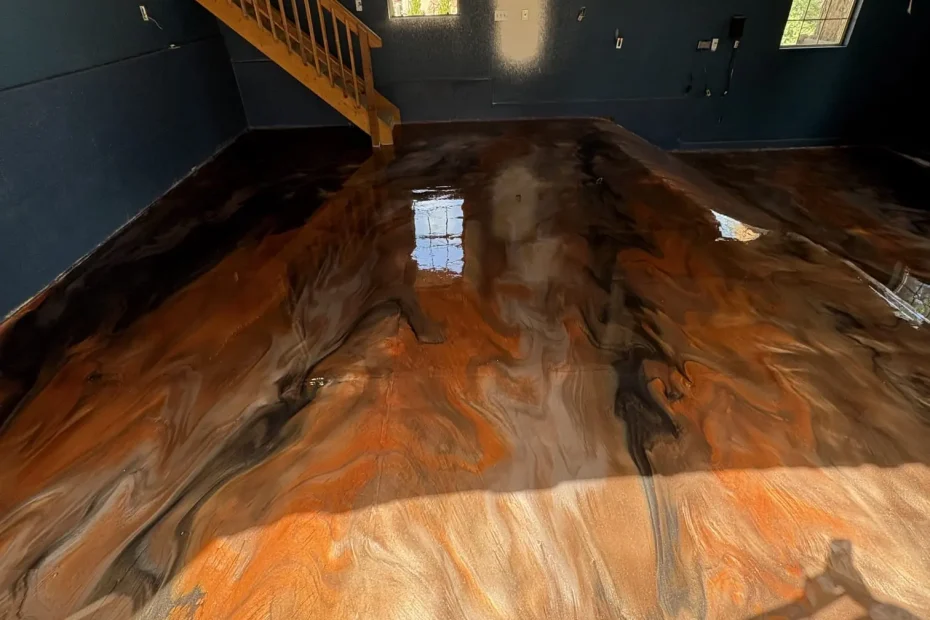
Metallic epoxy is a poured system. Pigments suspended in the resin swirl and settle as it levels, so no two floors move the same way. The copper, orange and black floor at the top of this post, set under a wooden stair railing against dark blue walls, shows how much depth a warm metallic brings to a room.
Warm coppers pair nicely with wood trim and railings. Smoky grays and silvers read cooler and quieter, which some owners prefer for a guest room.
Metallic has a smooth, glossy surface, so it belongs in rooms where people walk in socks more than in wet boots. It also shows dust and fine scratches more readily than flake. A rug at the bottom of the stairs and felt pads under furniture go a long way. Our Evergreen metallic epoxy page covers color choices and how a pour comes together.
Polished concrete for rooms that want nothing on top
Some owners want no film at all. Polished concrete is ground in stages, densified and honed to a sheen, so the finish is the concrete itself. There is nothing to blister or peel.
That makes polish a sensible fit for a workshop corner or a gear room over a slab with moderate moisture, since vapor can still pass out through the surface. A low sheen hides traffic and grit, and a polished floor sweeps quickly.
It has limits down here. Polished concrete shows the slab’s history, so cracks, old patches and color changes all stay visible. It also stays as cool underfoot as bare concrete, which means guest rooms usually get rugs. And it needs a sound slab to grind, so soft or heavily patched concrete is better covered.
Mixing finishes works well. A walk-out can carry flake in the gear room and metallic in the rec room, with the change landing at a doorway. Our Evergreen concrete polishing page walks through the grind levels.
Lower-level floor questions
Is my basement slab too damp for an epoxy floor?
Most are fine once the right primer goes down. We grind the slab and take moisture readings in several places, including along the buried wall. Higher readings call for a moisture-mitigating primer under the finish. If a slab shows standing water or an active leak, that gets fixed at its source before any floor is installed.
Which finish is warmest underfoot in a lower level?
All three sit on the same cool concrete, so none of them feels like carpet. Coatings add a thin layer that takes a little of the chill off bare concrete, and metallic feels smooth in socks. Area rugs and a well heated room make the biggest difference, whichever finish you choose for the space.
Can the stairs match the lower-level floor?
Often, yes. Flake coatings carry onto concrete stairs well, and matching treads make each step easier to see while tying the two levels together. Wood stairs need a different approach, so we check what yours are built from during the visit. Stairs next to a metallic room usually get a coordinating solid color instead of a pour.
Planning the Downstairs Floor?
Tell us how each room gets used, and we will test the slab and bring flake and metallic samples to compare.
Call (720) 635-0282 Request a Free LookEvergreen Metallic Epoxy · See basement floors · Evergreen services · Request a free look