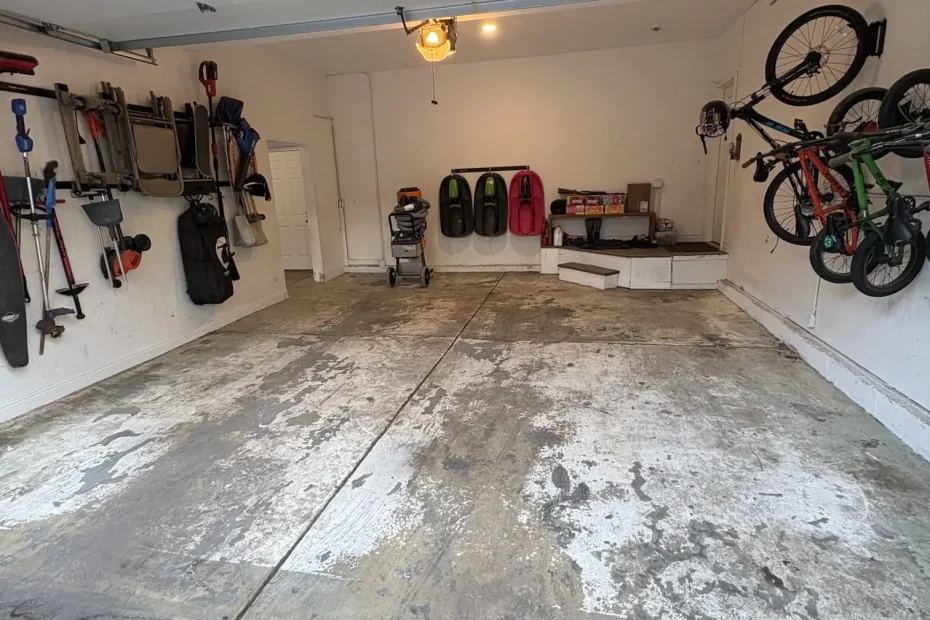

A mountain garage stores firewood, snow gear and trail equipment while trucks bring in sand and magnesium chloride on every trip. Bare concrete soaks up the brine and turns blotchy, and sand under tires wears it down. A sealed flake floor with a polyaspartic topcoat keeps the brine on the surface where it mops off, takes the grit, and hides daily dirt when the chip blend matches the colors that actually land on it.
What ends up on a mountain garage floor
Walk into an Evergreen garage in January and the floor tells the story. Ski boots drip by the door. Firewood sheds bark and pitch along one wall. Bikes, paddles and trail gear hang above a slab that catches whatever falls off them.
Then there are the vehicles. Road crews put down sand and magnesium chloride, and tires carry both inside. The truck parks, snow packed in the wheel wells melts, and a gritty, salty puddle spreads across the concrete and dries right where it sits.
Repeat that all winter and bare concrete ends up like the floor at the top of this post: patchy and stained, with an old coating flaking off in pale patches.
All of it is part of mountain life, and nobody is going to stop parking in the garage or stacking wood inside. The floor has to take it. Getting there starts with knowing what each of those things does to bare concrete, and what a coating has to do about each one.
Magnesium chloride and bare concrete
Magnesium chloride is a brine, and it keeps working after the snow is gone. It pulls moisture out of the air, so it stays damp far longer than plain meltwater would.
On bare concrete that damp brine soaks into the pores. As it dries it leaves a white crust, and over several winters it can soften the top of the slab and help the surface flake away. The pale blotches on an old garage floor are often exactly that.
A sealed floor changes where the brine ends up. With no pores to enter, it dries on top of the film as a haze you can mop away. Polyaspartic topcoats resist that chemistry well and stay clear.
Cleaning habits matter too. Brine left for weeks is harder to lift than brine rinsed after a storm. A squeegee that pulls meltwater toward the door, plus an occasional mop with warm water and a mild cleaner, keeps a coated floor looking right. Our Evergreen polyaspartic coatings page explains why that topcoat suits a garage like this.
Road sand under tires works like sandpaper
Road sand is sharp. Carried in on tires and boots, it sits on the floor and gets ground under every wheel that turns. On bare concrete it wears visible paths. On a thin paint or a roll-on kit, it scuffs through to gray in the tire lanes.
A full flake system handles abrasion much better, and the build explains why. The chips add body to the floor, and the clear topcoat over them serves as the wear layer. The broadcast also leaves a little texture, which helps tires and boots grip when there is meltwater on the surface.
Wear concentrates where tires stop and turn. We make sure the topcoat goes down at full thickness across the whole floor, parking lanes included, and never stretch material thin to reach the far corners.
The owner’s part is sweeping. Pushing sand out the door every week or two does more for a floor’s shine than anything else, because it clears the grit before tires grind it in. A wide push broom hanging by the door is the best tool a mountain garage can own.
Firewood, gear and the wall line
Firewood stacked on concrete leaves bark, pitch and moisture behind. Pitch sticks to a bare slab and darkens it for good. On a sealed floor it can usually be worked off with a plastic scraper and a cleaner that is safe for the coating. A rack that lifts the stack off the floor is still the better plan, since air moving under the wood keeps everything drier.
Gear drips. Wet boots and packs set down on bare concrete leave rings that never quite fade. A coated floor lets those spots dry clean.
The wall line takes a beating nobody expects. Bikes lean against it, storage bins get dragged along it, and meltwater collects where the slab meets the wall. We carry the coating tight to the wall and, when a garage calls for it, run it a few inches up the stem wall so water has no raw edge to work behind.
If a workbench or heavy tool stand sits on one side, mention it. Narrow feet under a lot of weight put real pressure on a small spot, and it helps to plan pads or a heavier build in that corner.
Picking a flake blend for grit and light
Color in a mountain garage is a practical call. Choose a blend that resembles the dirt landing on it, and the floor looks clean between sweeps.
Tan and gray mixes hide road sand well, since sand is tan and gray. The floor in the photo below uses a blend like that, and the band of sunlight falling across it from the open door shows how the chips break up the surface. Mid grays with some black handle tire marks. Very dark solids and bright whites show every speck.
Light matters too. A detached garage that swings from bright sun at the door to shade in the back will look different from end to end, and a busy blend evens that out. We set sample boards down in your garage so you see the chips in the light they will actually live in.
Chip size is the last decision. Larger chips hide more, while smaller ones read finer and more even. The Evergreen flake epoxy page shows the range, and our garage coatings page covers the build under the chips.

Winter garage floor questions
Will magnesium chloride stain a coated garage floor?
Brine dries on top of a sealed polyaspartic topcoat as a whitish haze and mops off with warm water. With no pores to soak into, it does not leave the deep blotches you see on bare concrete. Heavy residue left for weeks takes more effort to lift, so rinse or squeegee the floor after the worst storms.
How often should I sweep sand off a coated garage floor?
Every week or two through snow season is a good rhythm, and sooner after a big storm when the roads were heavily sanded. Grit left sitting on the floor gets ground under tires and slowly dulls the topcoat in the parking lanes. A wide push broom and a squeegee kept near the door make the job quick.
Can I stack firewood directly on a flake floor?
You can, and the coating will not absorb pitch or moisture the way bare concrete does. A simple rack that lifts the stack a few inches is still better, because air under the wood keeps it drier and stops bark and sap from sitting against the floor. Sweeping around and under a rack also stays easy.
Over the winter, rinse the brine film off a flake floor every few weeks. A mop and plain water are enough to do it.
Blotchy Floor and a Full Garage?
We look at the stains, ask how the space gets used, and bring chip samples to lay out in your own light.
Call (720) 635-0282 Request a Free LookEvergreen Garage Coatings · See flake floors · Evergreen services · Request a free look