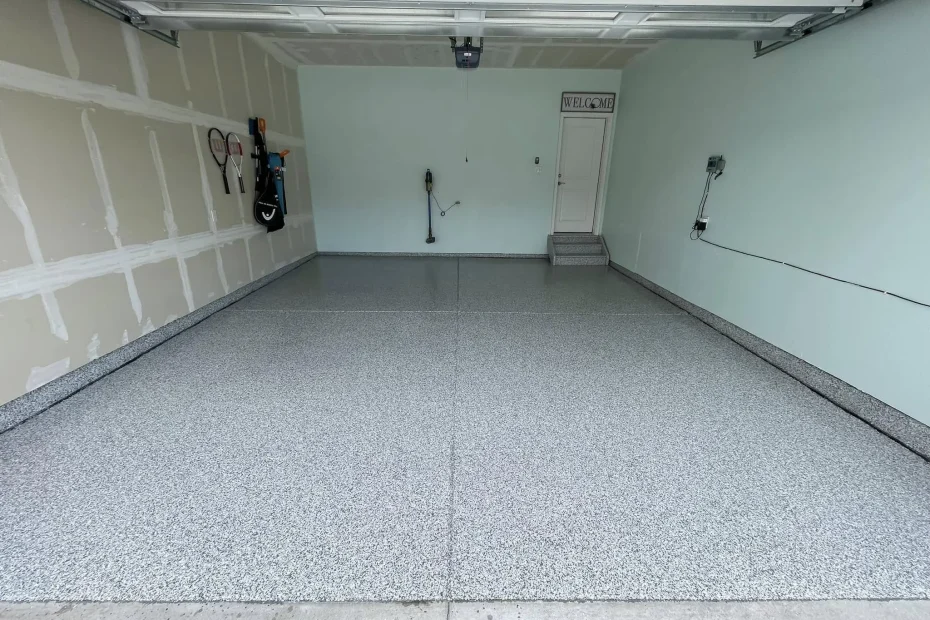

Aurora sits above 5,400 feet, where freeze-thaw cracks bare slabs and high-altitude UV yellows ordinary epoxy topcoats. A polyaspartic topcoat answers both. Its aliphatic chemistry resists UV so the floor does not amber, it seals the slab so meltwater never starts the freeze-thaw cycle, and it cures in 6 to 8 hours so you drive back the same day. For a Front Range garage, the topcoat is not a detail. It is the difference between a floor that lasts and one that fails.
Two forces quietly work against every garage floor in Aurora, and neither of them shows up on a sunny afternoon when you are looking at the concrete. The first is freeze-thaw. The second is altitude UV. Both are more aggressive on the Front Range than they are in most of the country, and both are handled by the same piece of the system: the topcoat. Understanding what each one does, and why a polyaspartic topcoat beats a standard epoxy topcoat at defeating them, is the single most useful thing an Aurora homeowner can know before coating a garage.
What Freeze-Thaw Does at Altitude
Concrete is porous at the surface. Water finds those pores. In Aurora, the daily temperature swing during the cold months is dramatic: a slab can sit in the 40s during a sunny afternoon and drop well below freezing overnight. Any water that has worked into the surface freezes as the temperature falls, and freezing water expands with real force. That expansion pushes the top layer of concrete apart from the inside. One cycle does nothing you can see. Hundreds of cycles across a few winters produce spalling: flakes lift, pitting spreads, and the floor develops the tired, dusty surface every older Aurora garage eventually shows.
Meltwater is the fuel. Every time a vehicle pulls in with snow packed in the wheel wells, water pools on the slab and soaks in. Every time de-icer and road treatment ride in on the undercarriage, they add a chemical assault on top of the physical one. A bare Arapahoe County garage floor is losing a slow battle to this all winter. The way you win it is not by fighting the freeze-thaw cycle after it starts, but by never letting it start: seal the surface so water cannot get into the pores in the first place.
Why Aliphatic Chemistry Beats Standard Epoxy
A polyaspartic topcoat seals the surface completely. Water sits on top and mops away instead of soaking in, so the freeze-thaw cycle has no foothold. That alone would justify the topcoat. But polyaspartic brings a second advantage that matters at Aurora’s elevation: it is aliphatic, and aliphatic chemistry resists UV breakdown.
Here is why that is not a technicality. UV exposure at more than a mile high runs meaningfully more intense than at sea level. Standard epoxy topcoats are aromatic, and aromatic resins yellow and chalk under sustained UV. On an Aurora garage floor, the near half of the slab gets direct sun every time the door is open through the summer. An epoxy-only floor drifts amber right there, developing an uneven tint that reads as aging. A polyaspartic-topcoated floor, because the aliphatic chemistry shrugs off the UV, still reads like install day years later. The garage door being open on a bright Colorado morning is exactly the test a lesser topcoat fails.
Epoxy and polyaspartic are not enemies, to be clear. Most high-performance systems use both: an epoxy base coat for adhesion, moisture tolerance, and film build, then a polyaspartic topcoat for UV stability, faster cure, and a harder surface. A polyaspartic-only system skips the base and bonds direct to the slab. Both approaches are valid depending on the concrete and how the space is used. The full breakdown lives on our Aurora polyaspartic coatings page.
The Same-Day Cure Advantage
The other thing polyaspartic brings to an Aurora garage is speed. It cures in roughly 6 to 8 hours versus the 24 to 72 hours a standard epoxy needs. Light foot traffic returns after 4 to 6 hours, and full vehicle traffic that same evening or the next morning depending on temperature and humidity. For a garage that doubles as the household hail refuge every summer, being able to get the vehicles back inside quickly is not a luxury, it is the point. A two-day cure window in the middle of storm season is a genuine problem. A same-day return is not.
The cure speed also makes cold-weather installs realistic. Polyaspartic has a wider install and service temperature range than standard epoxy, and the aliphatic chemistry handles the swing. We install year-round across Arapahoe County when concrete temperatures stay above 35 degrees and rising, so you do not have to wait for a perfect summer week to coat the floor.
Prep Still Decides the Outcome
None of this works without proper prep, and freeze-thaw makes prep even more important. We diamond-grind every Aurora floor to open the surface for a mechanical bond, HEPA-vacuum the dust, and fill every existing crack and joint with flexible polyurea before any coating goes down. That crack fill is critical in a freeze-thaw climate: the slab moves seasonally, and if a crack is not filled with a flexible material first, that movement telegraphs straight up through the coating. Filled correctly, the concrete can move underneath and the finish never shows it.
If you want to talk through whether a full polyaspartic system or an epoxy-base hybrid fits your garage, an on-site look is the place to start. We measure, check moisture, and walk through the options with no pressure. Call us at (720) 635-0282, or see finished Front Range floors in the gallery. The Aurora service page lays out everything we install locally.
Maintenance in a Freeze-Thaw Climate
A polyaspartic floor is built to make Aurora winters a non-event, and its upkeep reflects that. Through the cold months, a coated garage floor takes the worst of what the season delivers: packed snow melting off tires, de-icer and road treatment dragged in on the undercarriage, and the constant grit of winter driving. On a sealed polyaspartic surface, all of it wipes away with a broom and an occasional damp mop using a pH-neutral cleaner. Nothing soaks in, nothing etches, and nothing needs resealing on a schedule. Compared to the slow degradation a bare slab suffers every winter, the difference is stark.
The topcoat is what makes that low-maintenance promise hold over the long run. Because the polyaspartic is UV stable and rated for the temperature swings the Front Range hands out, it keeps its color and hardness for well past a decade of normal use. A residential install is backed by a lifetime warranty, and if a heavily used commercial floor ever dulls in its busiest lane, a topcoat refresh restores it without redoing the whole system. In a freeze-thaw climate, a sealed floor is not just easier to live with, it is the version of the floor that is still doing its job many winters later.
Aurora Polyaspartic and Freeze-Thaw FAQ
Does polyaspartic really hold up to Aurora freeze-thaw?
Yes. It seals the slab so meltwater never gets into the surface pores to start the freeze-thaw cycle, and the aliphatic chemistry resists the stress better than aromatic epoxies. The failure mode that spalls bare slabs simply does not get going under a sealed polyaspartic floor.
Why does altitude UV matter for a garage floor?
UV at more than a mile high is more intense than at sea level, and it yellows standard aromatic epoxy topcoats, especially on the near half of the slab that gets sun when the door is open. Polyaspartic is aliphatic and resists UV, so it does not amber over time.
How fast can I drive on a polyaspartic floor?
Light foot traffic returns in 4 to 6 hours, and full vehicle traffic the same evening or next morning depending on conditions. That is dramatically faster than the 24 to 72 hours a standard epoxy needs, which matters during hail season.
Can you install polyaspartic in winter?
Yes. Polyaspartic has a wider install and service temperature range than standard epoxy. We install year-round across Arapahoe County when concrete temperatures stay above 35 degrees and rising.
Do I need both epoxy and polyaspartic?
Not always. Many Aurora garages use an epoxy base plus polyaspartic topcoat hybrid for the best of both, but a polyaspartic-only system bonded direct to sound concrete is also valid. We recommend the right approach after seeing your slab.
Give Your Aurora Garage a Topcoat Built for the Front Range
We check your slab, walk through the system options, and give you a firm number with no pressure. Same-day cure, sealed against freeze-thaw.
Call (720) 635-0282 Elevate My Floor