

A floor that closes a business for a week costs more than the floor, so large commercial jobs get phased: part of the space stays usable while another part is coated. What makes that work is planning the break lines somewhere sensible, using systems that return the space in hours, inlaying the line marking rather than painting it on, and being honest about when wheeled traffic can come back.
Phasing is a drawing exercise before it is a schedule
The instinct is to phase by time: do half this weekend, half the next. That produces a break line wherever the shift happened to end, which is the wrong way round.
Phasing is decided by geography first. A cold joint across an open floor, where coating laid on one day meets coating laid on another, is visible for the life of the system. It should land under a wall, under a fixture, along a rack line or at a doorway threshold, somewhere the eye reads it as intentional rather than as a seam somebody left behind.
That means walking the space with you before anything is poured, working out which zones can be released at once, and where the boundaries can hide. It also means knowing what has to move. A bay full of racking is not a bay we can coat, so the phasing plan and your plan for shifting stock are the same plan.
What a phase actually looks like on the ground
A phase is a sealed-off zone with its own grinding, its own preparation and its own coating, running while the rest of the building carries on.
Containment comes first, because grinding is dusty and dust travels. The zone gets closed off, tools run on extraction, and the boundary is set so your traffic can still reach whatever it needs to reach without crossing wet product. Then the same sequence as any floor: grind to open concrete, treat the joints, prime, coat, topcoat.
Access routes matter more than people expect. If phase one takes the middle of a warehouse, everything that was crossing the middle now goes around, and somebody has to have thought about whether that route exists. We would rather work that out on a walk than discover it at seven in the morning with a crew on site.
Where a landlord sets a building standard, we want the standard document before the walkthrough. Building to it from the start is straightforward. Discovering it after a floor is down is expensive.
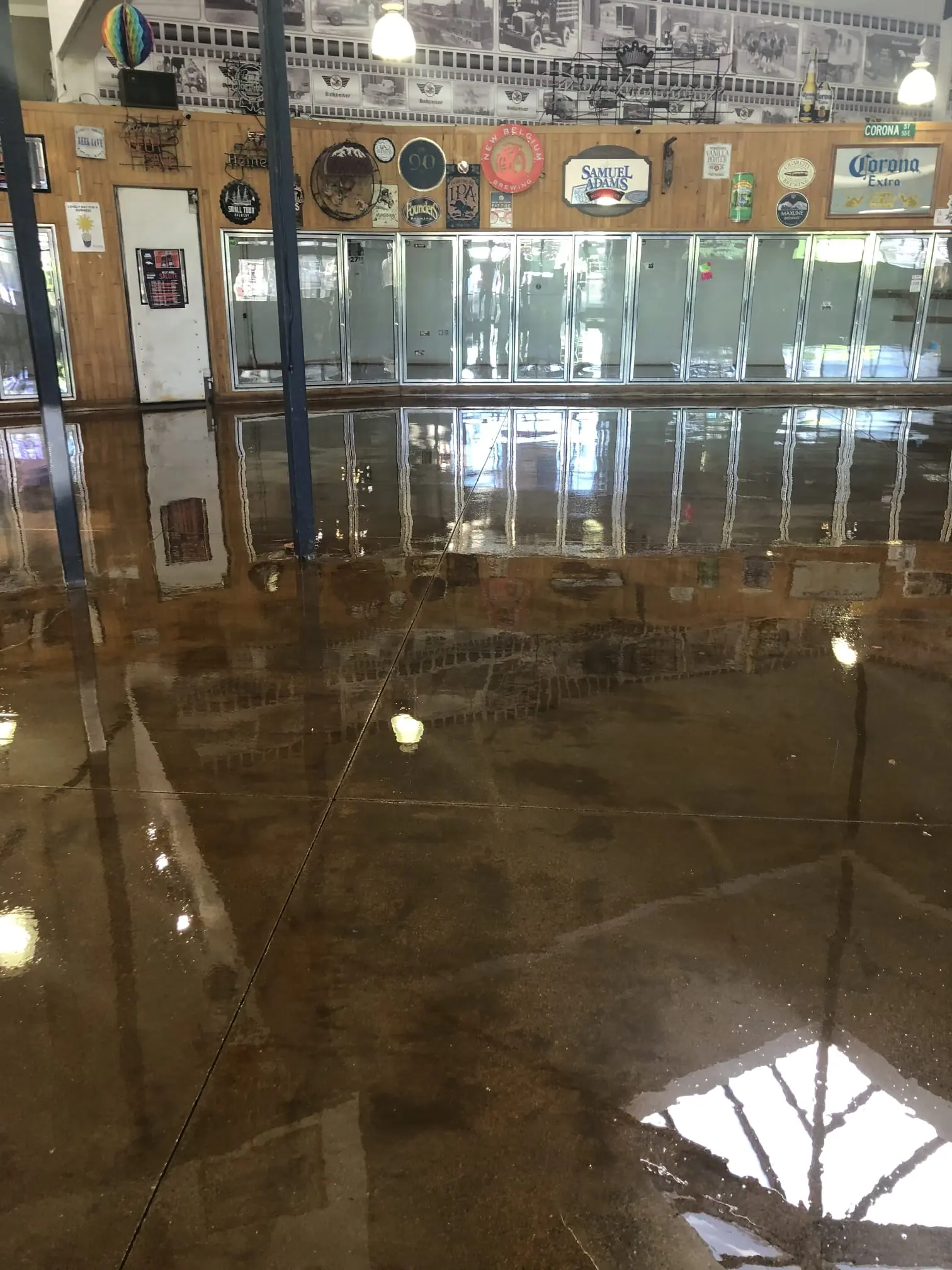
Speed is what makes phasing survivable
Phasing only helps if each phase is short. If a zone is out of use for four days, phasing a building into five zones means most of a month of disruption, and nobody wants that.
That is why fast-cure systems do most of the commercial work here. Polyaspartic returns a space to foot traffic in hours rather than days, which is what makes an overnight or single-weekend phase realistic. A retail unit gives us two nights running. A business park tenant gives us a weekend. A clinic gives us Friday evening through Sunday. Each of those is enough for a real zone if the system suits it.
Winter adds a decision. An unheated warehouse in January is below the cure threshold for standard epoxy, so the job either gets temporary heat brought in or gets specified as polyaspartic that cures cold. Both are legitimate and they cost differently, so it is a conversation rather than an assumption. We say which applies up front rather than booking the date and finding out on site.
Line marking that survives the traffic that crosses it
Most commercial floors need marking of some kind: walkway lines, bay divisions, safety markings, keep-clear zones at panels and exits.
Painted-on lines are the cheap version and they are the first thing to go, because they sit on top of the wear surface exactly where wheeled traffic crosses them daily. We inlay the marking into the floor instead, so the line is part of the system rather than a layer above it. It lasts years longer, which matters most in precisely the places where a line is doing safety work.
Inlaid marking has to be planned with the phasing, though. A line that crosses a phase boundary needs both sides of it to exist before it can be laid continuously, so marking generally follows the coating rather than traveling with each phase. Anything that has to be relocated later is worth flagging early: moving an inlaid line is real work.
If an inspector has given you a specific comment about markings or about a coved base in a food or medical space, tell us what it said and we spec directly against it. More on how that gets specified on our Centennial commercial coatings page.

When the forklifts come back
The question that decides a phasing plan is not when the floor is walkable, it is when it can take your actual loads.
Foot traffic returns fastest. Wheeled traffic is a different threshold, and steel-wheeled pallet jacks are far harder on a coating than pneumatic forklift tires, so the answer depends on what you run. Racking legs concentrate stress into small footprints, which is its own consideration, and it is one reason racking should not go back before a coating has reached its working hardness.
We give you those windows in hours rather than in vague reassurance, and we would rather add half a day to a phase than have you load a floor that is not ready. A coating loaded early does not fail visibly on day one. It fails quietly, months later, in the traffic lanes, and by then it looks like a product problem rather than a scheduling one.
The other half of that is joints. A large slab expands and contracts, so control joints get filled flexible and honored in the surface rather than coated over. Coat over a moving joint and a crack telegraphs through within a season.
Questions from Centennial operators
How many phases is too many?
There is no fixed number, but each boundary is a permanent line in your floor, so more phases means more visible seams. We aim for the fewest zones that keep your operation running, and we place each boundary where the building already has an edge.
Can you work entirely outside our hours?
Usually. Most of this happens overnight or across a weekend, and a single room is often one night. Tell us the hours you cannot close first, and the schedule gets built around them rather than the other way around.
Our slab is cracked and patched. Should we phase or fix first?
Depends on what the cracks are doing. Static cracks get filled rigid and disappear under the coating, and that happens inside the phase. Cracks still moving, or areas patched repeatedly, mean the slab itself is shifting, and sometimes the honest answer is concrete work before any coating.
Need a Centennial Floor Coated Without Closing?
Tell us your hours, what runs on the floor, and what it gets cleaned with. We walk the space and build the phasing around you.
Call (720) 635-0282 Request a Free LookCentennial Commercial Coatings · See finished floors · Centennial services · Request a free look