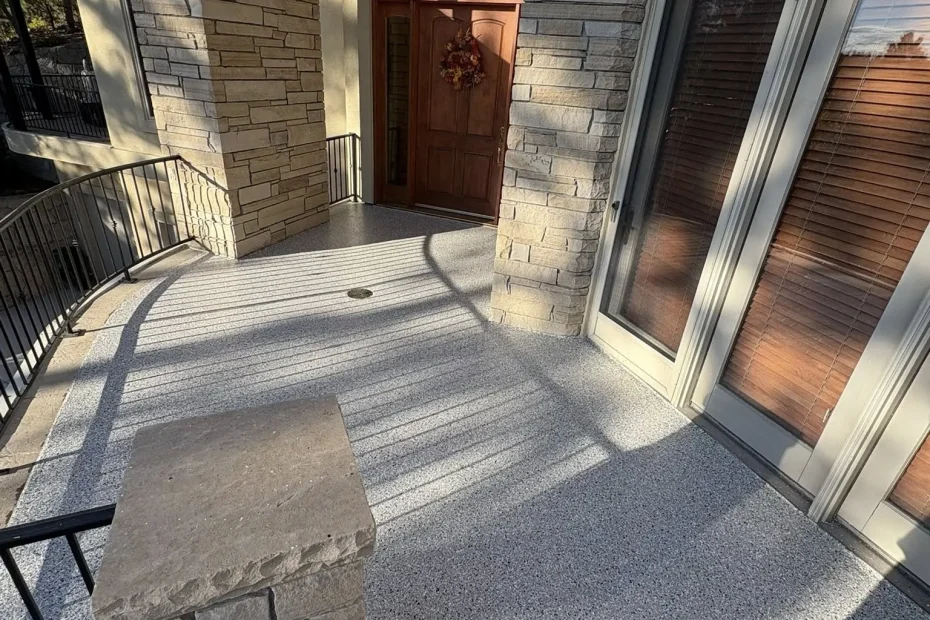

Magnesium chloride comes home on your tires every day from November through March, and it stays wet longer than rock salt does. Combine that with a genuine freeze-thaw cycle and you get spalling that starts exactly where the wheels sit. Sealing the pores stops the chloride reaching the concrete. What decides whether the seal holds is grinding, not the product name on the bucket.
Why the wheel tracks always fail first
Walk into an uncoated Centennial garage that has been through a few winters and you can read the damage like a diagram. The surface near the door is fine. The middle of the bay is fine. Two rectangles roughly the width of a car are flaking, and the flaking spreads outward from there. That is not wear from weight, and it is not coincidence.
Magnesium chloride is used across the metro because it works at lower temperatures than rock salt. It is also more aggressive on concrete, and it draws moisture rather than shedding it. Your tires pick it up off Arapahoe Road and Dry Creek, you park, and it drips onto the same two strips of slab every day for five months.
Concrete is porous. The chloride solution soaks in, sits there, and starts breaking down the paste that holds the aggregate together. The top layer eventually gives up in patches. That is spalling, and once it begins it accelerates, because every failed patch is a new low spot for the next load of melt water to pool in.
The freeze-thaw cycle is the second attack
Front Range winters are not steadily cold, which sounds like an advantage and is not one. A steadily frozen slab is stable. A slab that thaws every afternoon and refreezes every night is being worked.
Water finds its way into a hairline crack or an open pore. Overnight it freezes and expands, which opens the gap slightly. In the afternoon the sun on a south-facing door warms things up, the ice melts, more water gets deeper into the wider gap, and the cycle runs again after dark. Repeat that from November to April and a crack you could barely see in October is a real one by spring.
What makes this worse than it sounds is that the chloride and the freezing work on each other. The chloride keeps the surface damp longer, so there is more water available to freeze. The freezing opens more pathways, so the chloride reaches deeper. Sealing the surface is what breaks both halves of that at once: no water in, no chloride in.

Grinding is the whole argument
Here is the part that separates quotes that hold from quotes that do not. A slab that has taken five winters of chloride is contaminated in its top layer. Coating over that contamination bonds the new floor to concrete that is already compromised, and the whole system comes away in sheets when the compromised layer lets go.
Diamond tooling takes that surface down past the contamination, past old oil and tire marks, past any previous coating, and leaves open concrete with a consistent profile for the primer to key into. That profile is a physical texture, and it is what the bond mechanically depends on.
Acid etching is the cheap alternative and it does very little on a chloride-loaded Colorado slab. It is what an inexpensive quote substitutes for real preparation, and it is the single most common reason we get called to replace someone else’s floor. If a quote does not say the word grinding, ask what the preparation actually is before you compare numbers.
Cracks and spalled areas get rebuilt with rigid patching compound while the slab is still open. Anything left flexible telegraphs through the finish and reopens with the next freeze cycle, so that is not a step worth economizing on here.

Dry air, altitude sun and the door threshold
Two Colorado details change how a garage floor is built here rather than somewhere humid. The first is the sun. Altitude UV is stronger than it is at sea level, and a garage door that spends afternoons open lets it straight onto the slab. A standard clear coat ambers under that, which is obvious on a light color and less so on a dark one. Anything exposed gets a UV-stable topcoat as standard.
The second is the threshold. A lot of Centennial garages open directly into finished living space, and the door edge is where snowmelt collects and sits after a car has been parked wet. That junction is where a poorly finished floor starts lifting first, so the coating gets terminated properly at the threshold rather than run to the edge and stopped.
The dry air here helps more than it hurts. Low humidity keeps cure reactions moving, and it means a wet floor dries rather than sitting damp. What it does not do is protect the concrete from what the tires bring in, which is why the sealing still has to happen.
Two to three days, then seventy-two hours
A straightforward Centennial garage is two to three working days. Day one is grinding and repair. Then primer, a full broadcast of flake to refusal so no base coat shows anywhere, the excess scraped back, and two clear topcoats.
Foot traffic the next day. Vehicles after about seventy-two hours in normal conditions. Cold stretches that, sometimes considerably, which is why a January install genuinely takes longer than a June one. We would rather tell you four days in February and have you back on it early than promise three and be wrong about the one thing you actually care about.
If your floor has already started flaking, that is repair before coating rather than a reason to skip it. Those areas get cut back to sound concrete and rebuilt, then the whole floor is treated as one. It costs more than a clean slab and it is the honest price. Full detail lives on the Centennial garage coatings page, and every job carries our lifetime warranty.
Questions Centennial homeowners ask about winter damage
How much rinsing does a coated floor actually need?
Less than people expect. Once the concrete is sealed the chloride sits on the surface instead of soaking in, so it rinses off whenever you get around to it. Giving the wheel tracks an occasional rinse mid-winter helps and is not essential. The coating is doing the work, not the maintenance.
Is a hardware store kit worth trying first?
Most of the spalled garages we replace had one on them. A thin water-based product over an unground slab has no mechanical bond and no thickness to resist grit, so it goes through one Colorado winter and starts lifting. The concrete underneath keeps taking chloride the whole time.
Does a heated garage change any of this?
It helps with scheduling more than with damage. A heated bay lets standard epoxy cure properly in January, which widens the calendar. The chloride still arrives on the tires, and a warm floor means the melt water stays liquid and in contact longer, so the sealing matters just as much.
Want Your Centennial Slab Looked At Before Spring?
We read the concrete, tell you whether it needs repair first, and put a real number on it. Free, no pressure.
Call (720) 635-0282 Request a Free LookCentennial Garage Coatings · See finished floors · Centennial services · Request a free look